
The State of Resource Management in Legal 2026
WHITEPAPER – JAN 2026


ExecutiveSummary
1


Introductionto RM
2

RM in 2026
3


StrategicImpact
4


CapacityCase Study
5

Challenges &Opportunities
6

The Role ofTechnology
7

TheFuture
8


Conclusions
9
Brought to you by Capacity. Our platform enables law firms to realise the full value of strategic resource management. With integrated tools for tracking, reporting, automation, and allocation, Capacity provides a comprehensive solution that helps firms utilise their talent to their full potential.
”Legal Digest” mailer 📩
Key findings

14% average reduction in the utilisation gap
Resource managers have overseen a meaningful decrease in the gap between the busiest and quietest lawyers.

Associates trust RMs with information they might not otherwise share
More than 9 in 10 say associates come to them first.
Nearly half of work still bypasses RMs
45% of all work flows around, rather than through, the RM function.
KPI frameworks are still rare
Just 30% of RMs operate with established performance metrics.
Partner engagement remains inconsistent
60% say some partners have yet to fully buy in to the RM programme.
Workloads exceed what RMs consider ideal
More than 2 in 3 (69%) manage more fee-earners than they believe is sustainable.
Expansion is on the horizon
3 in 4 firms plan to grow their RM function within the next year.


ExecutiveSummary
1
The data gathered for this year’s report offers the clearest picture yet of how resource management is evolving inside leading law firms.
It’s clear the function has made measurable progress: narrowing utilisation gaps, strengthening relationships with associates, and embedding itself more firmly within the operational fabric of firms.
At the same time, we understand better the pressures RMs continue to face: inconsistent partner engagement, heavy workloads, limited KPIs, and the persistent volume of work that bypasses the function altogether.
Taken together, the insights illustrate a discipline that is simultaneously maturing and stretching.
Having worked closely with RMs for nearly a decade, I was delighted to see their value captured here — not only in the metrics, but in the human side of the role too.
At Capacity, we believe resource management is one of the most influential processes in large law firms. Resource managers sit right at the centre of it all, giving firms – and technology companies – the insight to work smarter and better.
We’re already looking ahead to next year’s report. If you’d like to take part, I’d love to hear from you.


William DoughertyCapacity Co-founder & CEO
Key:
Quotes from RMs who use Capacity are contained in these boxes.
More expansive RM impact stories are contained in these boxes.

Introduction
Over the past decade, resource management has developed from a nice-to-have to a must-have for large international law firms.
Leaders are increasingly recognising that innovation in staffing can be a powerful driver of efficiency, development, talent retention, and long-term competitiveness.
Yet despite its growing importance, resource management is still an emerging discipline in the legal sector.
In this paper, we share insights from 52 survey respondents and 21 in-depth interviews with practising law firm resource managers.
Collectively, they represent more than 235 years of experience in the legal sector. This is a first-of-its-kind report on their experiences, challenges, and successes.
In publishing their insights, our goal is to inspire best practices, foster collaboration, and help shape the future of resource management in law firms.
With data collected in Q3 2025, this report marks the first in an annual series. To contribute to the 2027 edition, or to receive updates on future reports, ensure you’re signed up to Capacity’s newsletter. You can do so on capacity.law.
Demographics
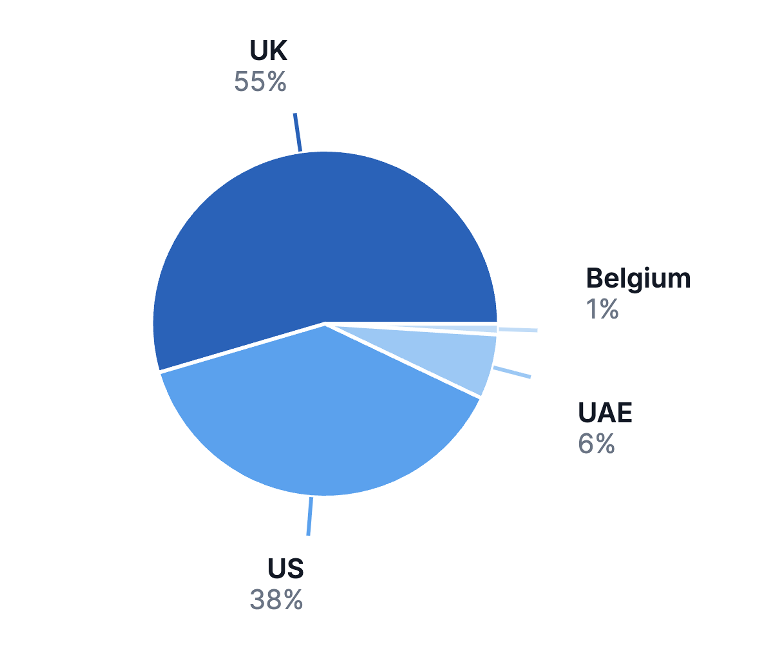
Where do you work?
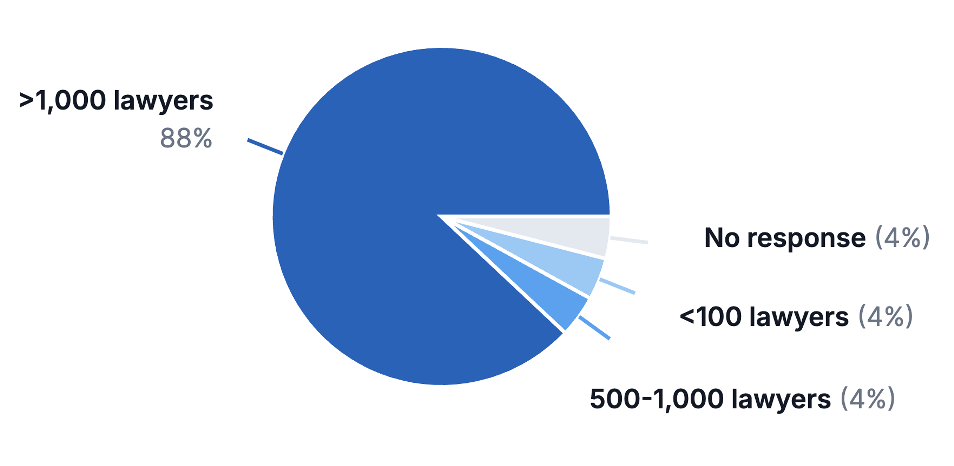
How many lawyers are there at your firm?


Introductionto RM
2
Resource management is long established in consulting and professional services firms, where it has been used to optimise talent utilisation and performance for decades. As law firms have expanded and client expectations around efficiency and cost control have grown, the legal sector has increasingly embraced the function.
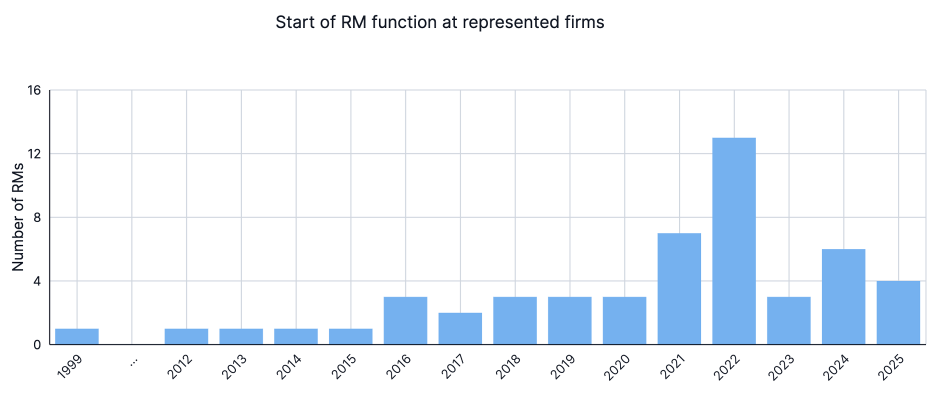
Most firms represented in our survey created their resource management function between 2016 and 2022. With a median tenure of five years, most RMs have had time to get their feet under the desk – but may be yet to become fully established.
When firms launched resource management
Most programmes emerged between 2016 and 2025.
Acknowledging the relative novelty of their roles, interviewees described how misconceptions about the function, and a limited understanding of their work, are barriers to broader engagement. So who are resource managers, and what do they do?

“Some people still don’t understand what we do, or think we’re just admin support. That makes it harder to have the right conversations.”
“There’s a misconception that RM is just work allocation – but it’s a lot more than that.”
Who are resource managers?
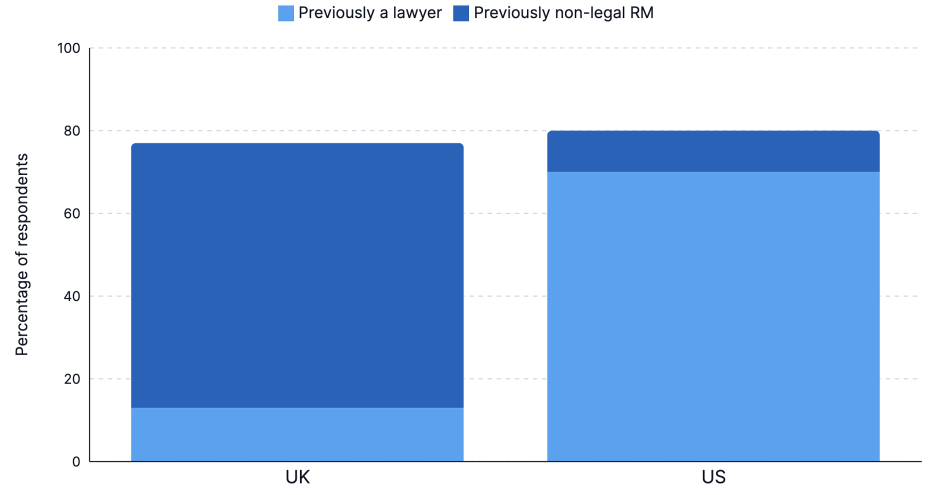
Our survey responses indicate there are two distinct routes into law firm resource management. Some RMs move into the legal sector from a similar role in the Big Four. This route is more established in the UK, with these RMs tending to report they “fell into” their law firm roles.
Others become an RM having previously worked as a lawyer, often within the same firm – a path that’s currently more common in the US.
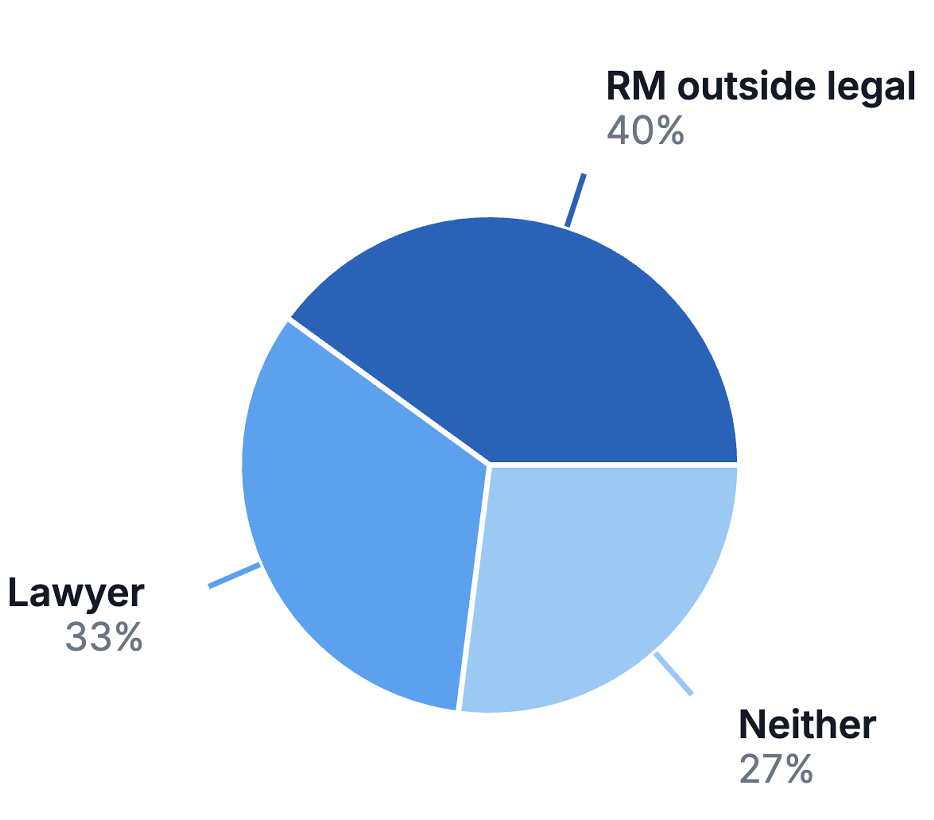
Previous experience of resource managers
Almost 3 in 4 had previous experience as a lawyer or an RM outside legal.
Both types of RM face a learning curve: former lawyers must learn the ins and outs of resource management, while those new to the legal sector must grasp the nuances of legal work and the unique culture within law firms.
Background of UK and US resource managers
Radically different hiring approaches exist on either side of the Atlantic.
“People who have trained at a consultancy generally come in with a good awareness of what resource management is, and the levers they need to pull to make things happen.”
“Legal experience helps. If a partner asks for somebody to support an M&A transaction, you can't say, ‘well, I've got this tax associate over here.’”
Key traits
Resource managers occupy a unique, holistic position within their firms. Several interviewees emphasised that they “wear different hats,” operating between departments to deliver a mix of resourcing, analysis, and pastoral care.
“We're a depot of information, and we’re constantly funnelling that data out to different people: to HR, to talent, to finance.”
Besides their resourcing responsibilities, respondents were evenly split between viewing their role as primarily pastoral or primarily analytical. In reality, as we shall see throughout this report, resource management involves a large dose of both.
57%


Say their role is largely pastoral.
55%
Say their role is largely analysis and reporting.
We asked each of our interviewees for the traits they see as most important to be a successful resource manager. This word cloud shares their most frequent responses.
Most important traits for resource managers
Resilience was cited by 90% of interviewees.
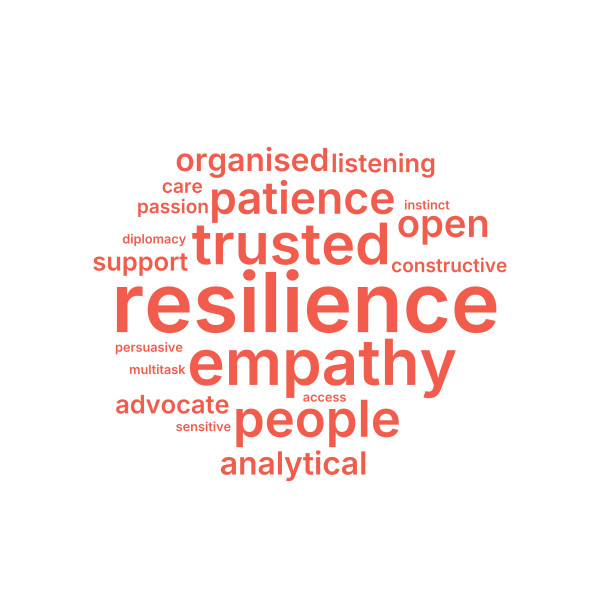
Resource managers consistently emphasised strong people skills as essential to their role. The most frequently cited trait – mentioned by 90% of interviewees – was resilience. For RMs, this often means the ability to withstand partner pushback and persuade juniors to take on less desirable work.
“Thick skin. You’re pushing back against very experienced partners. You need to be able to negotiate, to say ‘I can’t give you exactly what you want, but here’s an alternative that still works.’”
On the other hand, RMs need to build trust and rapport with juniors and seniors alike. Many also provide informal pastoral support, acting as a safety valve for overworked or vulnerable associates who may hesitate to raise concerns elsewhere.
“Sometimes we’re a safe space to vent, to shout, even to cry. Our role is about listening, understanding, and really building those relationships.”
This experience is almost universal among RMs: nine in ten survey respondents said they often hear concerns that would otherwise go unspoken, and unresolved, within their firms.
92%

Say associates trust them with information they might not otherwise share.
Every resource manager we interviewed shared at least one story illustrating how valuable this unofficial, backchannel communication and support can be for law firms and their lawyers.
“I had an associate. A hard worker, but prone to stress. She's tells me: ‘I've been working hard to get pregnant, and I’m finally pregnant – with twins – but I'm not announcing yet because it’s early stage. I’m worried about preterm labour.’ So I helped manage her schedule, keeping her safe from demanding work, from difficult people. She went on to have her babies, and she was extremely grateful. In any case, it's not good to put her on a deal that's going to go months and months – we’d have to replace her, and all that institutional knowledge, and ask the client to pay more money to get somebody else up to speed. So it worked for her and it worked for us.”


RM in 2026
3
To assess the state of resource management in 2026, we asked respondents to describe the scale of their functions. An interesting pattern emerged: firms with 1,000–2,000 lawyers employed the most RMs, while the very largest firms had among the fewest.
Number of RMs versus lawyers at the firm
Firms with between 1,000 and 2,000 lawyers have the most RMs.
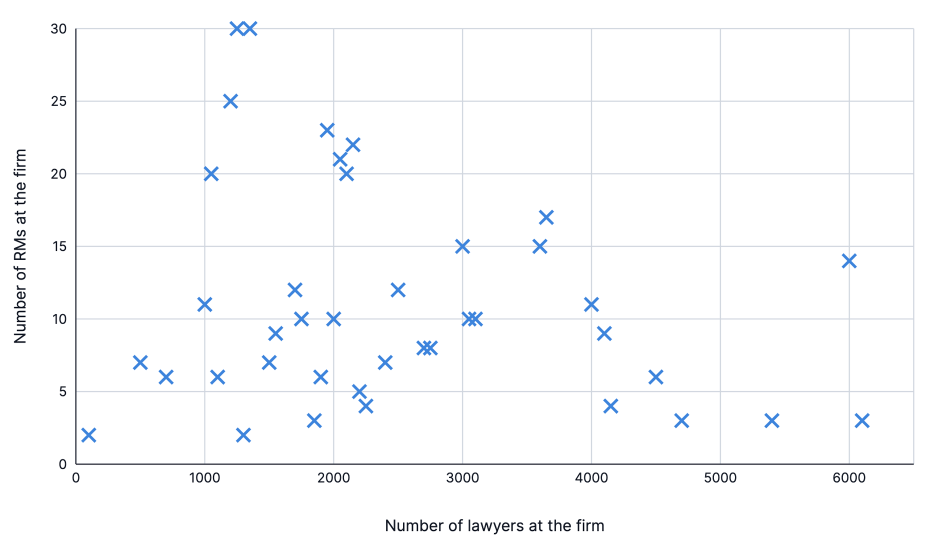
The data reveals wide variation in the deployment of the RM function across firms. Some large firms have as few as one RM per 2,000 lawyers, suggesting RMs are active in very few teams, while others operate at ratios below one to 100, suggesting a whole-firm roll-out.
Number of resource managers: UK versus US
US firms have more RMs than UK firms, on average.
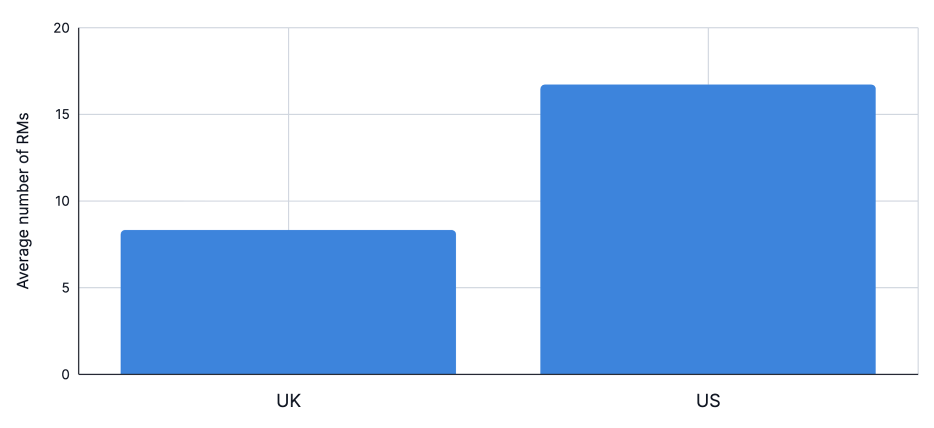
This disparity may also reflect differing strategic approaches to the function, with some firms opting to replicate the Big Four model in which RMs have a more limited role but manage far larger teams.
“In consulting, I was looking after a larger number of people. I would put them on a project and that's it – off they go for six months, and you don't have to worry about them until they pop up in your system again. Whereas in legal, people are always here unless they’re on secondment. I’m constantly talking to them, constantly giving them work, and discussing what they like about it. So you are forming stronger relationships with people. That's one of the things I really value about working in legal.”
However, most RMs said their firms are planning to expand their teams, suggesting their programmes are regarded as successful by firm leaders.
75%

Say their firm is planning to expand the RM programme in the next year.
56%

Say their firm is planning to hire more RM personnel in the next year.
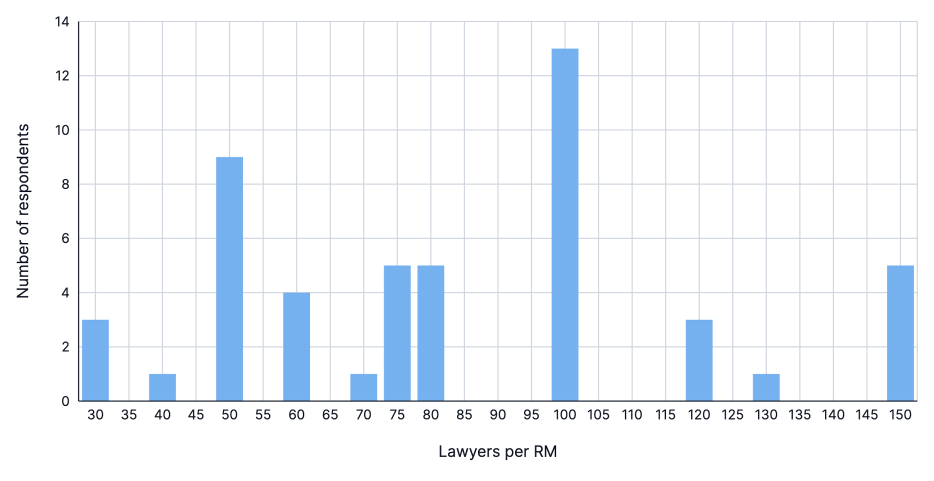
Survey respondents were also asked to identify their ideal ratio of RMs to lawyers. Responses varied from 1:30 to 1:150, though most clustered between 1:50 and 1:100. On average, the RMs we surveyed would like to be responsible for 82 lawyers.
Resource managers’ ideal RM-to-lawyer ratio
RMs would prefer to oversee 82 lawyers, on average.
Many RMs emphasised that the ideal ratio will vary by team and practice area. Fast-paced groups typically need more RM support, while teams with junior lawyers require greater oversight than those with more experienced fee-earners.
“Disputes requires less frequent resourcing because the matters are larger and longer-lasting. But transactional practices such as Real Estate require more day-to-day resourcing – so more work for the RM.”
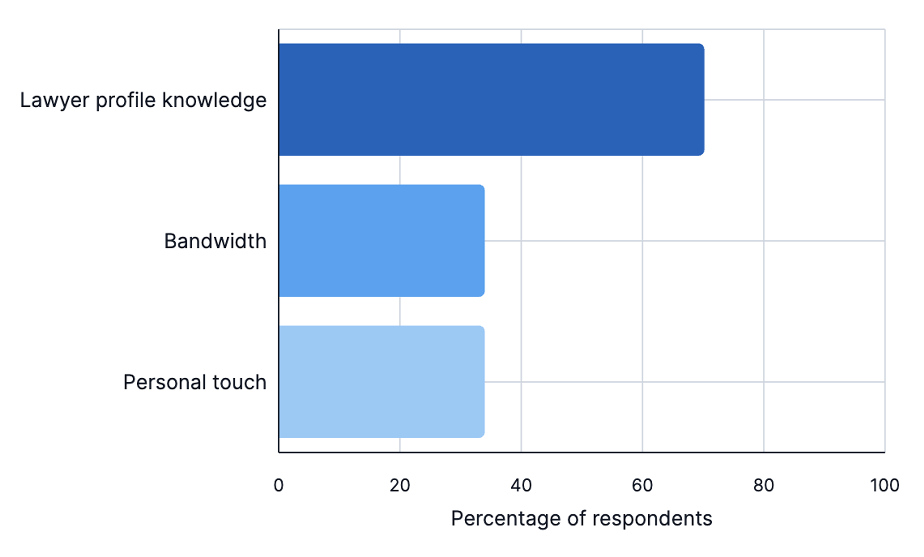
When asked to explain their ideal ratio, RMs cited three closely linked factors: maintaining personal relationships, fulfilling all responsibilities effectively, and building a detailed understanding of each lawyer’s professional profile.
Why resource managers would limit team size
Two in three cited the ability to know each team member’s profile.
Resource managers want to serve teams that they can realistically get to know, support, and serve on a personalised basis. Above a certain threshold, that service becomes impossible and their role becomes more transactional.
“Every fee-earner requires something different, and it’s important we have time to deliver the service to each of them. From my experience, any more than 130 people becomes unmanageable.”
Respondents also shared the size of the teams they manage. The smallest was 15 lawyers, the largest 380, with an average of 128. Nearly half (48%) oversee 100 or more lawyers, while only 14% manage fewer than 50. On average, RMs are managing 46 more lawyers than they see as ideal.
RM actual team size versus ideal team size
On average, RMs are managing 46 more lawyers than they see as ideal.
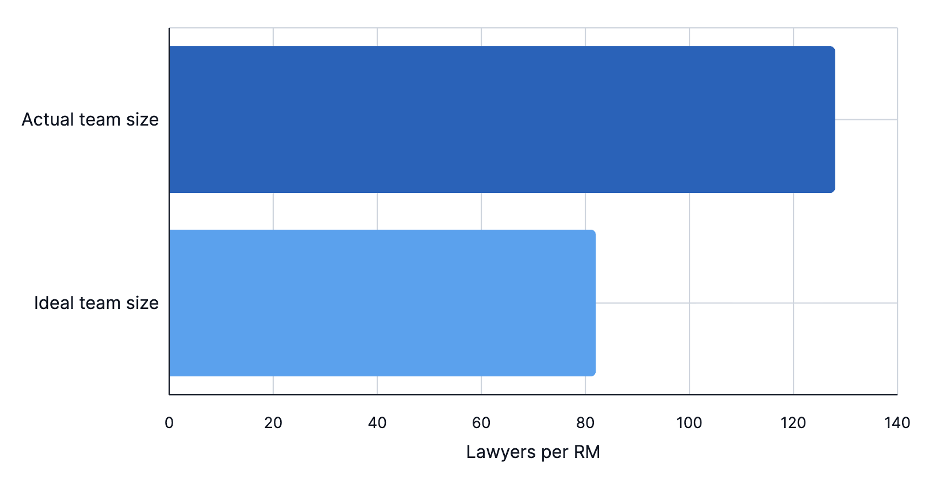
Comparing each resource manager’s ideal ratio with the size of their team, more than two-thirds are managing more lawyers than they consider optimal. Some 15% are managing teams more than twice the size they consider ideal.
69%

Manage more lawyers than they think is ideal.
Finally, those surveyed were asked which of their firm’s practice groups are currently covered by the RM function.
Practice group coverage
Resource management is most deployed in fast-paced teams.
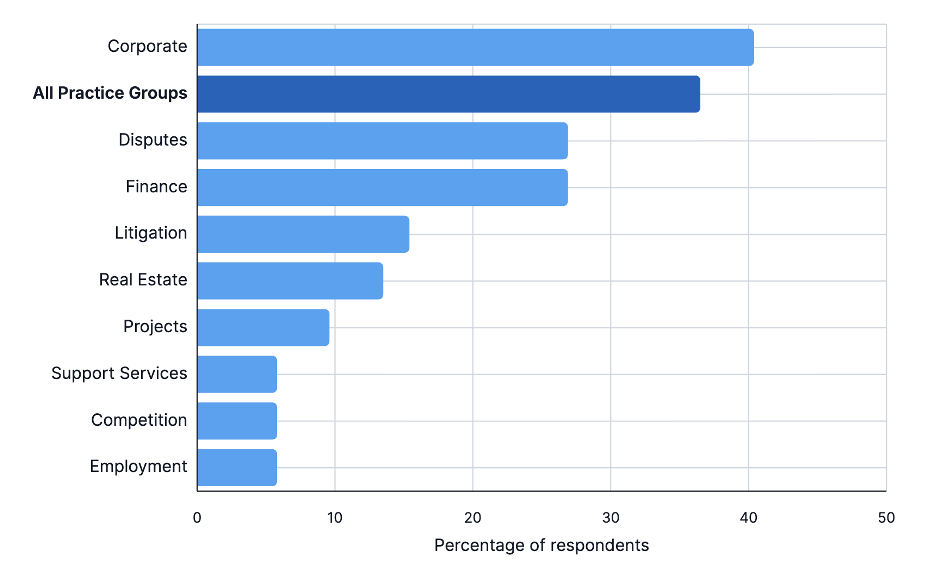
Fast-paced teams are over-represented in these findings, suggesting that firms are prioritising RM support for practice groups with a higher turnover of work.


StrategicImpact
4
As resource management becomes more established across the legal sector, its impact across a diverse range of firms and practice groups is becoming clearer. With most resource managers having spent several years in their roles, they are well placed to assess how their work is shaping team performance, firm culture, and fee-earner wellbeing.
When asked to rate their influence across key areas, respondents identified their strongest impact on wellbeing (8.6/10), smoothing utilisation (8.3/10), and talent retention (7.8/10) – three priorities at the heart of what resource management seeks to achieve.
Perceived influence over key areas
RMs believe they have the greatest impact on wellbeing.
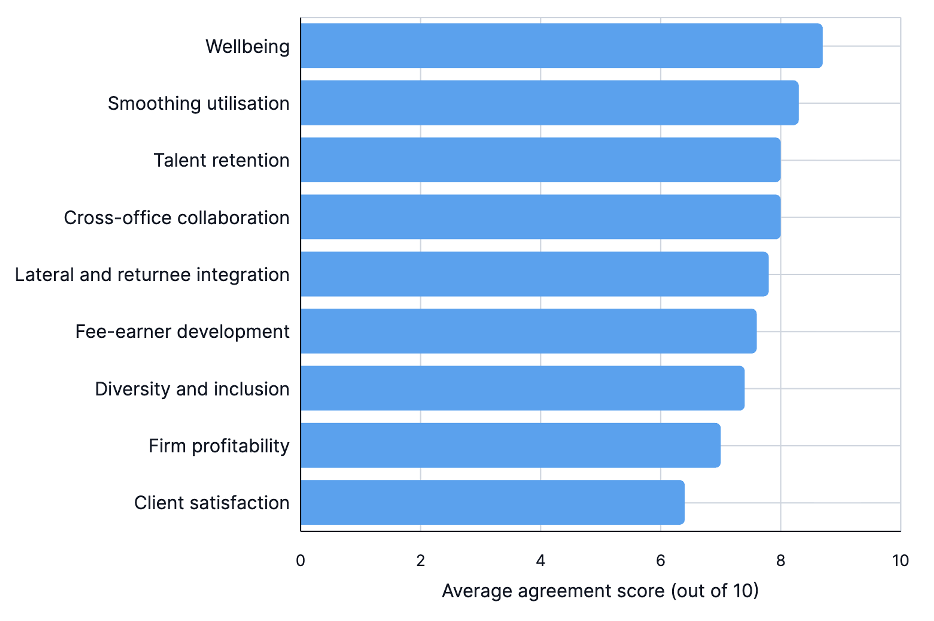
Interestingly, respondents were less confident about their impact on profitability and client satisfaction – areas where the benefits of resource management may be harder to assess and quantify. This likely reflects a maturing function, still evolving from an administrative role to one of strategic influence across the firm. Several interviewees noted that this shift is already well under way within their own organisations.
“We're not just chasing forecasts and filling requests any more. We work with every group: HR, finance, recruitment, wellbeing, D&I, pricing. We help break down the structure of the teams we’re putting forward to clients. We're even part of pitch documents now. Partners include sections about resource management: how we staff matters, or what we consider when building teams.”
When given the access they need, having earned the trust of senior lawyers, resource managers can support a wide range of firm functions. But the impact most central to their role, and top of mind for nearly every RM, is smoothing utilisation.
Smoothing utilisation
One of the key objectives of resource management is to distribute work more evenly – reducing the number of associates working far above or below target.
This is described by resource management professionals as smoothing utilisation, flattening the utilisation curve, or narrowing the utilisation gap. It’s widely regarded as a core KPI of resource management – with caveats.
“Utilisation targets are useful, but you have to have the work. If you don’t have the work, then those targets will be unachievable.”
To explore this key metric, we asked survey respondents to report their team’s current utilisation gap and indicate whether resource management had helped to reduce it. Notably, only 5% of respondents couldn’t provide this data – underscoring its centrality to their work and how they assess their performance.
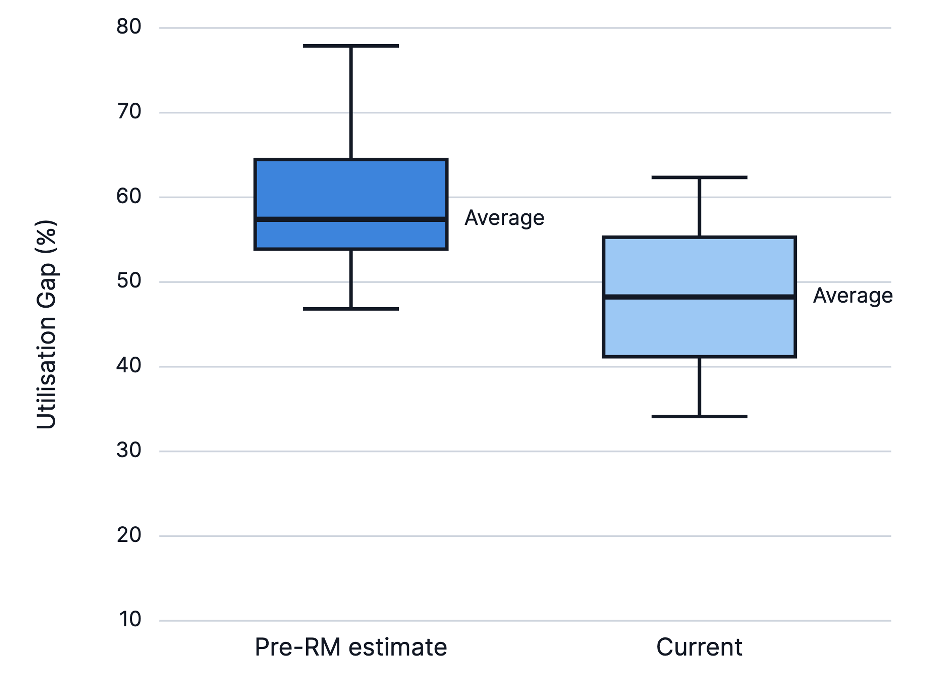
50%

Average pre-RM utilisation gap.
36%

Average post-RM utilisation gap.
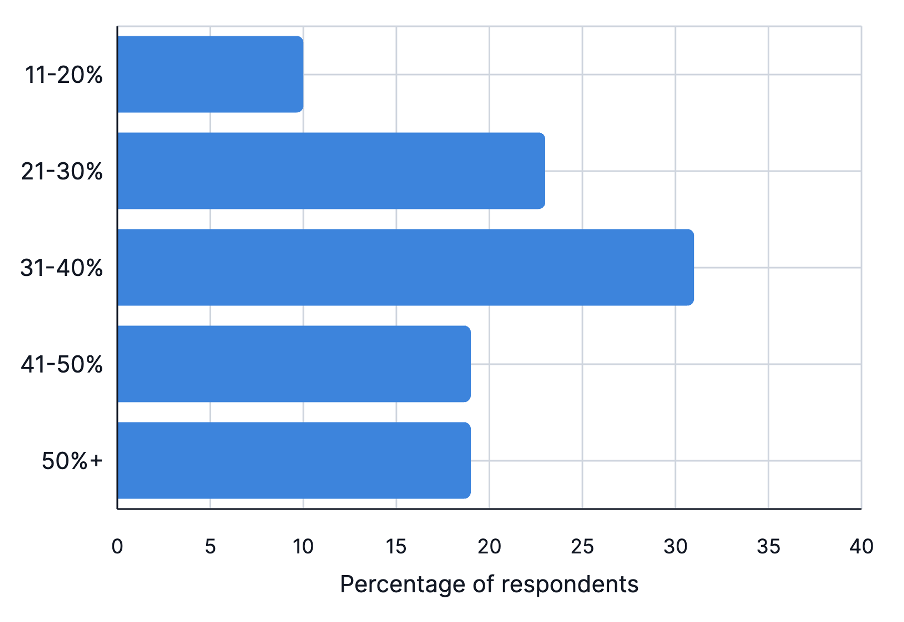
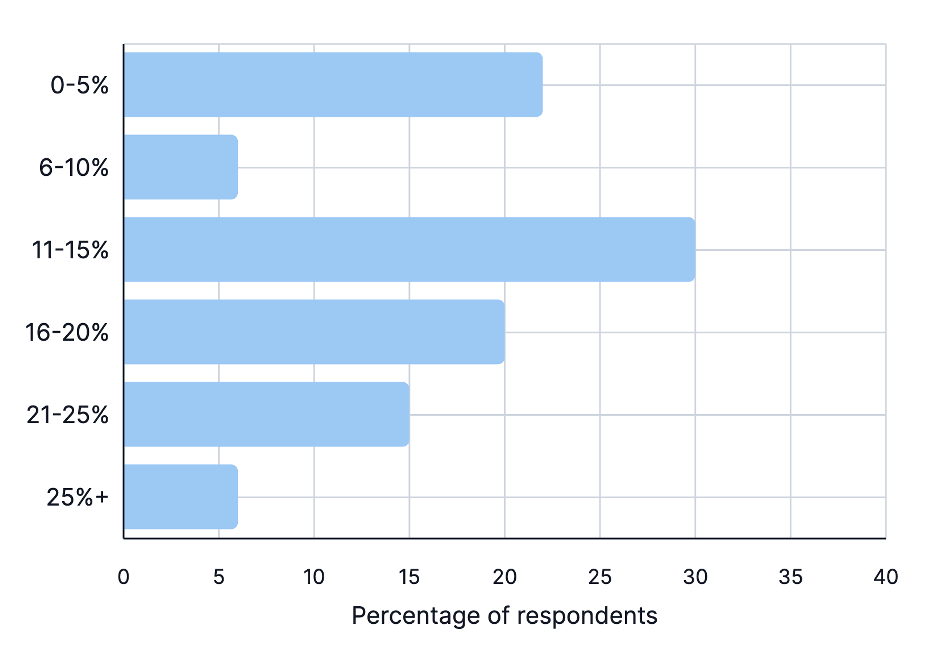
Across our sample, resource management reduced the utilisation gap by an average of 14% – a strong result for a relatively new function. Two in three respondents (68%) reported a current utilisation gap exceeding 30%, with none having reduced it to 10% or below. However, every RM said they had helped narrow their team’s gap, with seven in ten reporting a reduction of more than 10%.
Current utilisation gap in RM teams
Two in three report a utilisation gap exceeding 30%.
RM’s reduction of the utilisation gap
Seven in ten report a reduction of more than 10%.
RM impact on the utilisation gap
RMs have reduced the utilisation gap by an average of 14%.
Unsurprisingly, programme maturity was strongly correlated with overall improvement: firms with older RM programmes and larger RM teams achieved the greatest reductions to their utilisation gaps.
Our interviews revealed that the utilisation gap is often viewed as a measurable proxy for the broader, less tangible benefits of resource management. We asked survey respondents to identify those benefits.
Perceived benefits of utilisation smoothing
Fairness and reduced burnout rank as the top benefits.
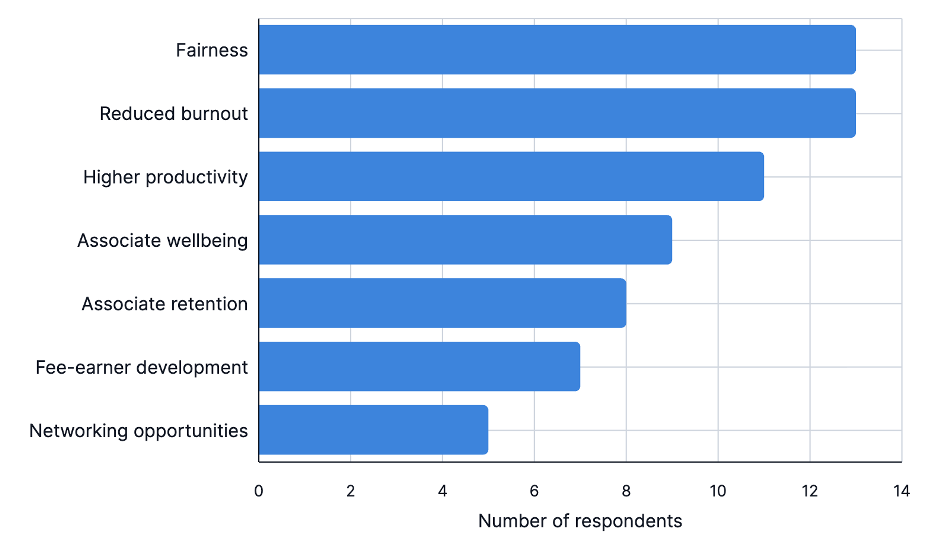
The reported benefits underscore the win-win nature of resource management: supporting healthier, more engaged associates who stay longer and contribute more to their firms and clients.
“It's about ensuring every attorney has fair access to opportunities, supporting their skills development, and building a broad, highly capable talent pool to meet client demands – while safeguarding the wellbeing of those with the heaviest workloads.”
Some firms may focus on raising the hours of their least busy lawyers. But as one RM noted, protecting promising talent from overwork is just as important as supporting those at risk of underutilisation and disengagement.
“On the other hand, some associates do just put their heads down and work. In some cases, I will explain that ‘no, you need to take out 400 of these hours. You had 3,000 hours, so take four or five hundred of these hours and turn them into interacting with the partnership, going out for drinks, and using your BD money.’ We had two associates like that become partners this year – and I felt I influenced that. It's those stories, those interventions, that are sometimes overlooked.”


CapacityCase Study
5
The utilisation gap is a core KPI we at Capacity use to measure the effectiveness of our solution as it’s deployed across new teams.
In one team at a leading law firm, Capacity was adopted to help its resource managers narrow the utilisation gap and optimise workload distribution.
Using Capacity, the team’s resource manager tracked associate data, generated reports, and intervened when partner assignments appeared suboptimal. The utilisation gap was measured before implementation and again six months later.
54%

Utilisation gap before Capacity.
18%

Utilisation gap after six months using Capacity.
This 36% reduction in the utilisation gap is unprecedented in the legal sector. The team began with an above-average gap but, six months later, ranked in the top tenth percentile for utilisation balance among all teams in this report.
The RMs in this team said they typically checked in with associates when utilisation fell below 70% or approached 100%, to assess under- or overwork. Capacity helped keep workloads within the right range, reducing the need for reactive interventions.
Utilisation range before and after Capacity
Capacity helped RMs achieve a 36% reduction in the utilisation gap.
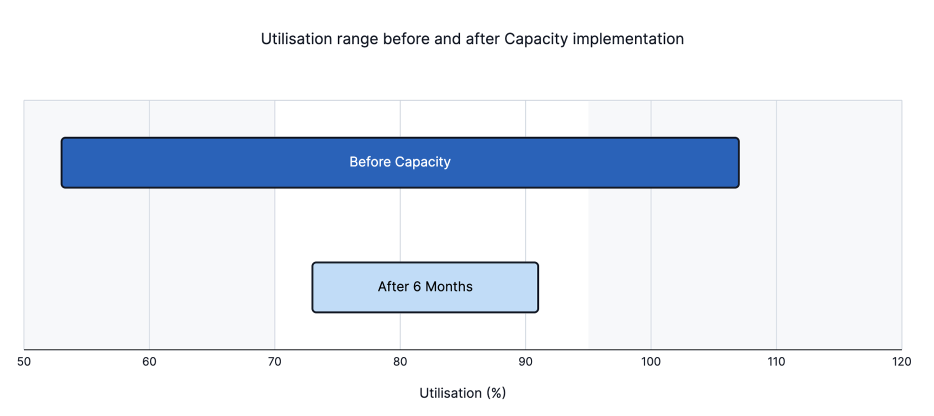
In this period, 119 matters and 1,001 tasks were created and staffed in Capacity – an average of 8 tasks per day. The majority of these tasks did not require the RM’s intervention, freeing up time for higher value work.
“Capacity ensures we no longer shoulder responsibility for every individual resourcing request. Partners use the system independently, and I step in only when we need to consider how to optimise a situation, resolve an issue, or refine the reporting. My role has become more strategic.”
With more time freed up, RMs can focus on higher-value activities such as workforce planning, pastoral support, and talent development. The resource manager in this team estimated that Capacity saved them between three and four hours per day.
50%
Reported time recovery for RMs using Capacity.
Capacity is intentionally flexible, allowing firms to deploy it in different ways. Some teams have resource managers enter all work into the system, others encourage fee-earners to use the work allocation features directly where appropriate, and some opt for a hybrid approach.
The programme’s success has smoothed adoption across the firm, giving other RMs confidence and momentum as they prepare to implement Capacity themselves.
“I recently met with a team that doesn’t yet use Capacity, and they said they’re genuinely looking forward to adopting it. To me, that speaks volumes – it shows we’re building advocates not only for Capacity, but for effective resource management more broadly.”
Fee-earner attrition is another clear indicator of Capacity’s impact. Before implementation, attrition in the team stood at 12.7%. Around a year after deployment, it had fallen to 7.7% – a reduction of more than one-third year on year.
39%
Decrease in associate attrition in teams using Capacity after one year.
Research indicates that losing a single associate can cost between $500,000 and $1 million. On that basis, Capacity’s impact on retention could be delivering savings of several million dollars for this team alone.
We’re proud to support resource managers across firms and practice areas as they formalise and centralise their approach to resource management – unlocking the full productivity potential of their people.

Challenges &Opportunities
6
As a growing function, it’s natural for resource management to encounter challenges along the way. We asked RMs to share what’s holding them back – and what lessons could help the function continue to evolve and gain momentum across the legal sector.
One theme came up repeatedly: time. RMs report feeling stretched – across too many lawyers, too many matters, and too many competing responsibilities. As one RM put it, regaining time would mean “moving from managing panic to managing people.”
We asked RMs how they currently spend their time. The good news: RM programmes are reducing the time required to allocate work. The less good news: despite greater formalisation, 40% of respondents still spend most of their time on work allocation – which means less time on longer-term, strategic activity.
71%
Say the RM programme has reduced the time it takes to allocate work.
40%

Say they spend the majority of their time allocating work.
Resource managers don’t just allocate work – though several interviewees said this remains a common misconception. While work allocation focuses on assigning tasks to fee-earners, more holistic resource management involves a far broader set of responsibilities that underpin team performance and strengthen the firm as a whole.
RMs told us that there’s still a communication challenge in helping senior lawyers understand that allocation is just one part of a much broader role.
“The role extends far beyond allocating work. There’s pastoral, there’s coaching, there’s wellbeing, there’s analysis. It carries genuine advisory weight, and that influence is strengthened when we can support our recommendations with robust data.”
Our survey found that two in three RMs believe they could enhance their pastoral support with more time, and over half said additional time would enable better analysis and reporting.
67%

Say they could deliver more value if they had more time for pastoral activity.
55%

Say they could deliver more value if they had more time for analysis and reporting.
High-quality reporting can have a powerful long-term impact on team profitability, but those reports must be regarded as legitimate for groups to act on their insights.
“Years ago, I saw a spike in public sector IPO work coming. By aggregating partner insights and Capacity data, I warned we needed to hire or risk turning work away. Unfortunately, we didn’t act in time. We became overloaded, missed opportunities, and ended up hiring late and at higher cost, bringing in people who weren’t the best fit. Some team members burned out or permanently pulled back, reducing our long-term capability.”
Ultimately, firms must decide how much they’re willing to invest in resource management. Expanding RM teams, supported by technology that automates their most time-consuming tasks, may be key to unlocking the function’s full strategic potential.
The ‘cultural hump’
Resource management depends on cultural change and partner buy-in to succeed. Many partners remain accustomed to delegating to familiar associates, and such ingrained habits can be hard to break – especially in firms where the function is still considered unproven.
“It all comes down to overcoming the cultural hump. You can sit around a table outlining all the advantages of the function, and everyone will agree enthusiastically – that part is easy. The real test comes on Monday morning, when you’re asking someone to change the way they work.”
RMs unanimously agreed that partner buy-in is essential to programme success, yet nearly two-thirds said some seniors remain unconvinced. This may frustrate RMs, but most interviewees told us they understand partner resistance and view winning seniors over as part of their role.
100%

Say partner buy-in is essential for the success of the RM programme.
60%

Say some seniors have yet to buy in to the RM programme.
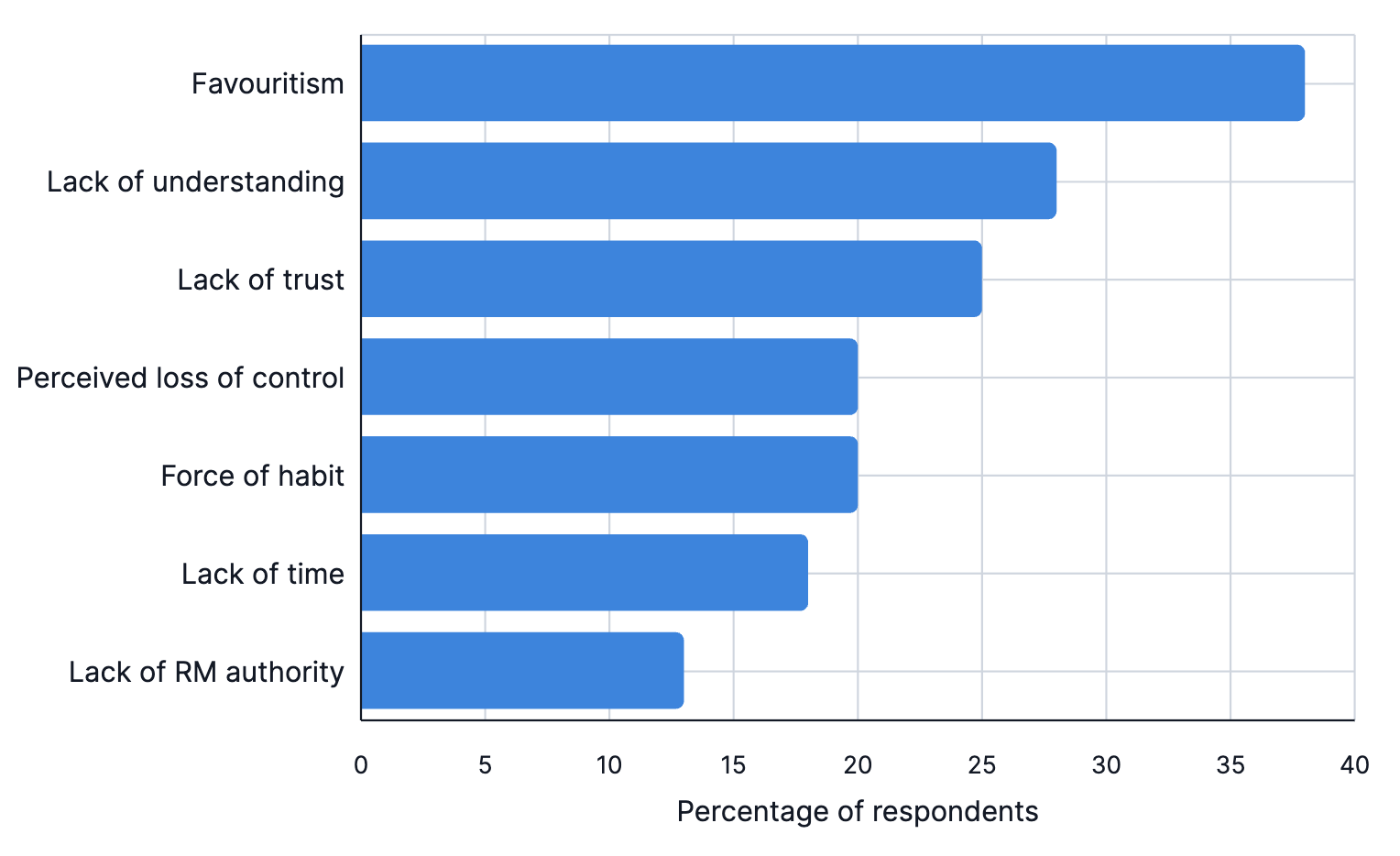
Respondents cited favouritism as the main barrier to senior buy-in, noting that partners often prefer familiar associates and hesitate to release them for other matters. Trust also emerged as a key issue: some partners are wary of assigning work to juniors they don’t know, and others doubt that RMs have the authority to influence or override their staffing choices.
Barriers to senior buy-in
Favouritism was cited by more than one in three respondents.
“The teams that have followed my advice are seeing strong results. Where teams have chosen a different path, challenges are emerging. We can provide the tools, but that doesn’t guarantee success – which is why the shift in mindset is so important.”
“Inconsistent adoption among partners and senior lawyers means the system can only operate partially, creating a tiered environment where some follow the guidelines and others don’t. This leads to operational issues, mutual frustration, and ultimately undermines the credibility the system needs to deliver its value.”
When senior lawyers aren’t fully behind the programme, they tend to continue doing things “the old way.” Our survey found this to be the case, to varying degrees, across all RM teams – with a significant minority reporting that fewer than one in three tasks are routed through the RM programme.
Volume of work routed through RM programme
Nearly half (45%) of work remains outside RM programmes.
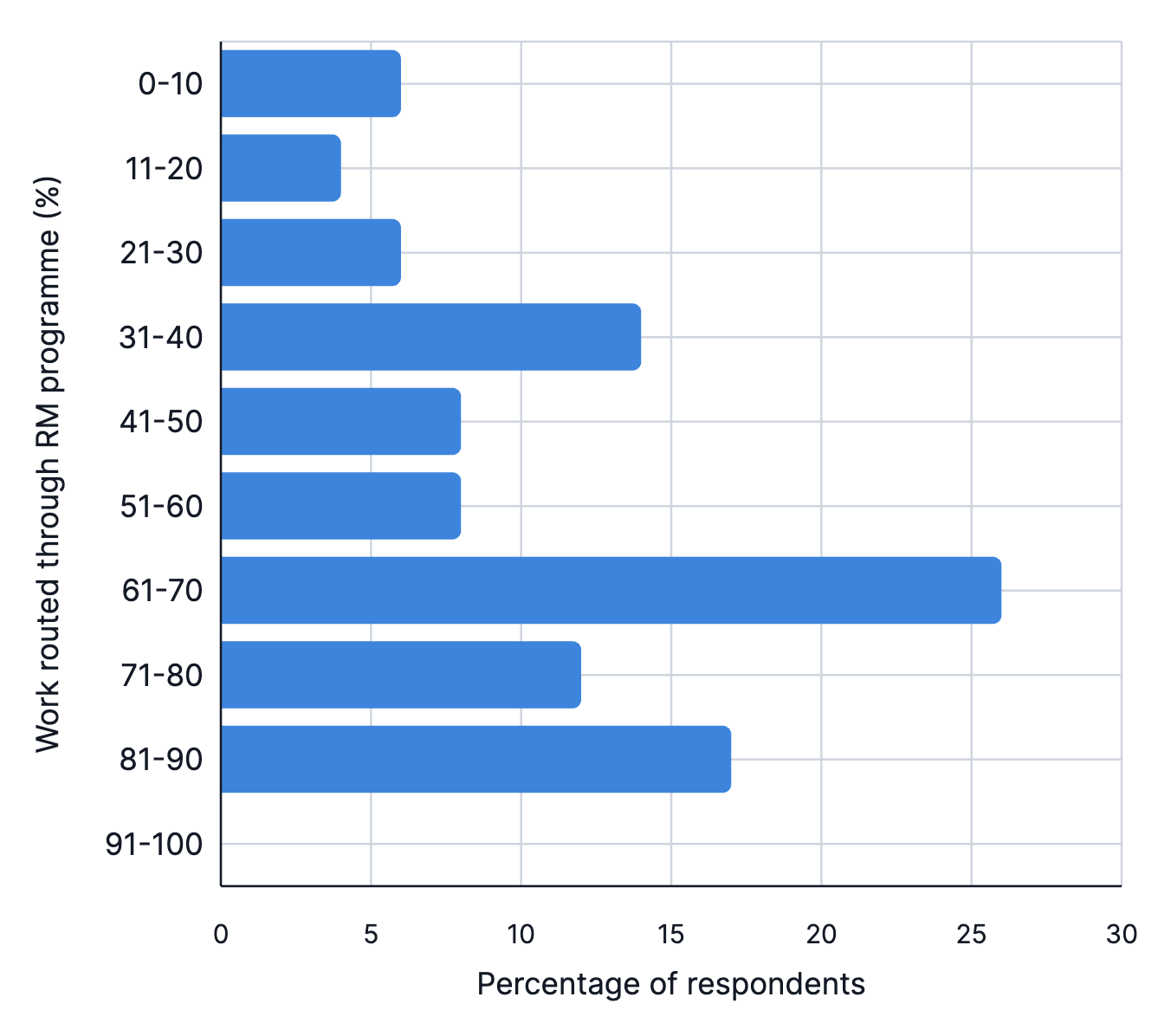
On average, RMs report that only 55% of work currently passes through their RM programmes. This suggests that some senior lawyers prefer to bypass the system, or that some teams may prefer for certain work to be assigned outside the system.
“Some partners need a nudge to ensure all work is put through Capacity. When activity happens outside the system, that’s when our value is diluted and our fee-earners begin to feel the strain.”
Some interviewees suggested that partners might use RM programmes to offload less desirable work. Our survey tested this assumption and found that nearly two-thirds (65%) of respondents disagreed, with fewer than one in five agreeing.
45%

Of work still bypasses the RM programme, on average.
17%

Say the work that goes through the RM programme is the least desirable.
Buy-in issues are far from universal. Many interviewees cited partners who have become active champions of their programmes, and three-quarters of respondents agreed that partners recognise their value to the firm.
75%
Say partners understand the value they contribute to the firm.
“Where buy-in is strong, it works brilliantly. One partner made it clear the system was non-negotiable and led by example. Usage soared, the team became more diverse, and the culture shifted. That’s what we need elsewhere.”
It’s not only senior lawyers who sometimes disengage from the RM function. Some juniors also fail to participate fully in the programme – often requiring encouragement to reengage.
“One associate was struggling to secure work post-secondment. They’d disengaged from the system and hadn’t updated their preferences. I encouraged them to take a few moments to do so, and by the end of the week they had three strong assignments, including one with a preferred partner. It showed how small, informed adjustments can deliver significant results.”
Still, some seniors continue to view RM as an administrative layer rather than a strategic asset. Our interviewees believe that demonstrable wins – such as improved utilisation, faster staffing, and successful new connections – can help change perceptions, build trust, and shift long-standing habits.
A lack of KPIs
Which brings us to the next challenge: the lack of defined KPIs for resource management. While two-thirds of RMs said their firms have a clear resourcing strategy, fewer than one in three reported having formal KPIs to measure the effectiveness of their work.
65%

Say their firm has a clear resourcing strategy.
30%

Say they work with formalised KPIs.
The absence of formal KPIs is understandable: as one interviewee put it, the function “is not an exact science.” Others noted that much of a resource manager’s value is difficult to measure, particularly the pastoral, ear-to-the-ground elements of their work.
“There’s no KPI for the pastoral side of the role, nor for the insight it enables me to provide to senior stakeholders. You’d be surprised by how much you observe in this position – who’s thriving, who’s finding things difficult, who people enjoy working with, where there are tensions. All that means we act as an early warning system when individuals are at risk of burnout.”
Despite this, almost every interviewee, when asked about their KPIs, wanted to know what other firms were measuring. There’s a clear appetite for more robust metrics – for better ways to evidence to senior stakeholders what RMs already see in practice.
“We’ve saved nearly 1,000 hours of partner time on resourcing alone. When you multiply that by the average partner rate, you’re looking at significant savings.”
To help consolidate emerging resource management KPIs, we’ve compiled a list of the metrics shared with us through interviews and our broader work with resource managers.

The utilisation gap
Changes in overall utilisation
Proportion of work requests routed through the function
Fee-earner engagement survey results
Feedback from fee-earner interviews
Profitability: whether the most cost-effective resources were selected
Partner time saved
Diversity and inclusion alignment
Wellbeing outcomes
Growth in internal connections and collaboration
Reduction in associate sick days
Many of these KPIs are already monitored by law firms. RM teams in search of additional KPIs may wish to push for stronger alignment with the metrics used by other departments and programmes.
“We’ve aligned our wellbeing KPIs with our resourcing KPIs. That way, when we speak to partners, we’re not just warning ‘this person is too busy’ – we’re saying, ‘this affects their wellbeing and performance.’ It’s a stronger message.”
Resource managers shared a strong appetite to connect: to discuss potential KPIs, exchange best practices, and contribute to the growth and recognition of the function across the legal sector.
Throughout 2026, Capacity will help build and strengthen these connections by engaging resource managers via our mailing list to arrange structured roundtables, peer discussions, and collaborative forums, creating a consistent platform for knowledge-sharing and professional development.

The Role ofTechnology
7
Resource managers sit at the intersection of two worlds: one deeply human, the other highly data-driven. They’re expected to collect, process, and analyse fee-earner data while maintaining the personal connection that builds trust and fosters a sense of belonging within their firms.
“It’s a people role – we just need the data. For me, data is the greatest enabler. In an ideal setup, you glance at a dashboard and immediately know which partner to speak to about whom.”
Technology is designed to enhance – not replace – the role of resource managers. Its purpose is to relieve RMs of time-consuming manual data collection and processing, allowing them to focus on the strategic and human elements of the job that technology cannot replicate.
Two in three survey respondents reported using dedicated resource management software, with adoption broadly consistent across US and UK firms.
67%
Use dedicated resource management software.
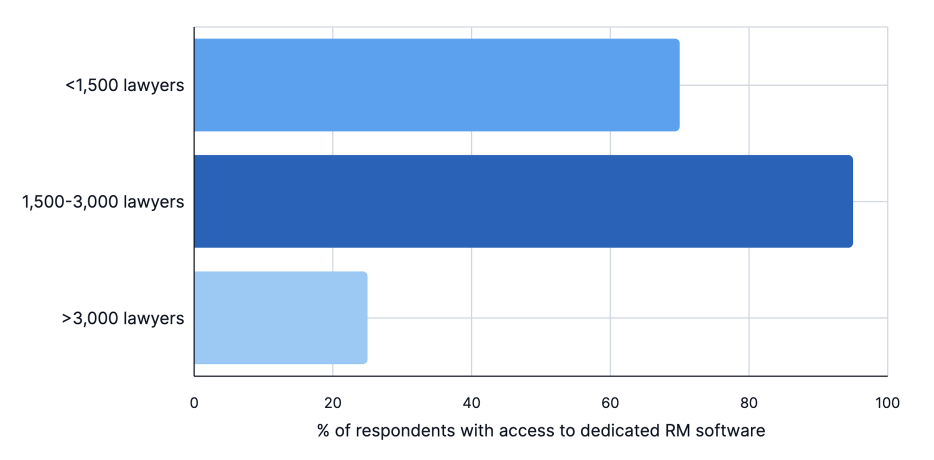
Surprisingly, the largest firms represented in our survey (those with more than 3,000 lawyers) were far less likely to have deployed RM software than firms with between 1,500 and 3,000 lawyers (25% versus 95%).
This may reflect the distinct procurement processes of the world’s largest law firms, as well as the structural barriers that can make agile technology adoption more difficult at that scale.
Access to RM software versus firm size
The largest firms are least likely to use RM technology.
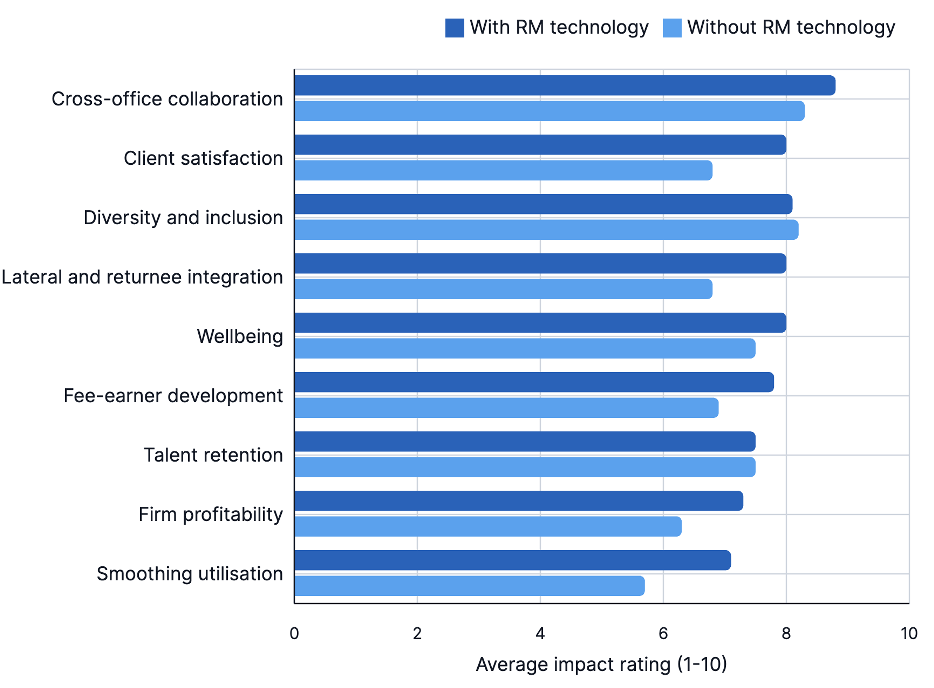
On average, RMs with access to dedicated software rated their impact higher than those without specialised technology. The difference was most pronounced in areas such as client satisfaction and lateral and returnee integration.
RM impact with and without technology
RMs using specialised software report greater impact.
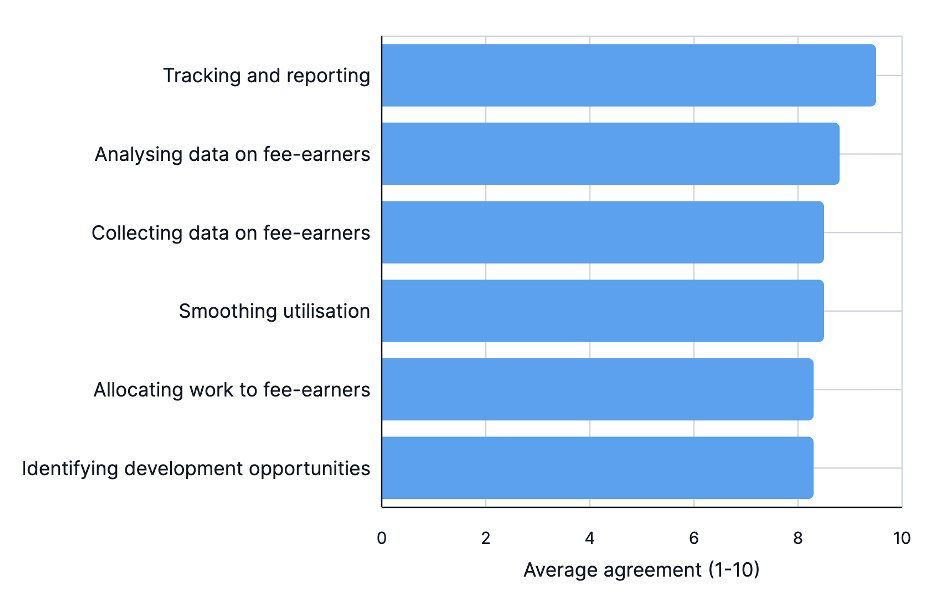
Whether or not RMs reported using specialised software, more than four in five said they could do a better job with better technology. Respondents believed that tracking and reporting would benefit most from better technology, followed by fee-earner data analysis and collection.
83%

Say they could do a better job with better resource management technology.
Where technology could be most impactful
RMs see technology as most helpful in managing data.
RMs most closely associate technology with the data side of their roles – the aspect many described as most tedious when handled manually. Just two in five respondents said they find it easy to gather fee-earner data, even before accounting for the time required to organise and analyse it for staffing decisions.
42%

Say it’s easy to gather data on fee-earners.
“I used to spend half a day each week compiling reports – four or five hours not engaging with stakeholders or focusing on strategic work. With technology, you get to the answer quickly, freeing up time to consider the real question: ‘What should we do with these insights?’”
“Before Capacity, everything was manual. I had to speak personally with more than 100 lawyers about their aspirations and track all of it myself. I did my best, but inevitably human error crept in – you remember the most vocal person, or the last conversation you had, rather than the best fit. It was the stone age of resourcing.”
While technology is a valuable and welcome tool for RMs, respondents and interviewees were clear that it can never replace them – no matter how advanced it becomes.
“Tech can’t know what’s happening in someone’s life. It can’t replace relationships, chats over coffee, or personal insight. That’s human.”
At Capacity, we’ve seen the firms we work with significantly increasing their RM headcount. As one interviewee noted, technology can strengthen the case for hiring more RMs, rather than serving as a reason to reduce their number.
“For the first time, we have systems that return rich, actionable data. Once firms understand the insights available – about workload, skills gaps, profitability – they’ll realise they need experienced RM teams to act on it.”
Overall, RMs expect technology to continue enhancing their capabilities in the near future. But what lies ahead for the function itself? What’s next for resource management in the legal sector?

TheFuture
8
Resource management is still developing in the legal sector, but its trajectory is becoming clearer. Future-facing firms increasingly recognise that innovation in this area delivers significant returns – from stronger retention and higher productivity to time savings and a healthier firm culture.
“Ten years ago, resource management barely existed in law. Now, it’s growing fast.”
Three-quarters of survey respondents told us their firm plans to expand the function – a clear sign that firms that have already invested in resource management see its value and intend to build on early successes.
75%
Say their firm is expanding its RM function.
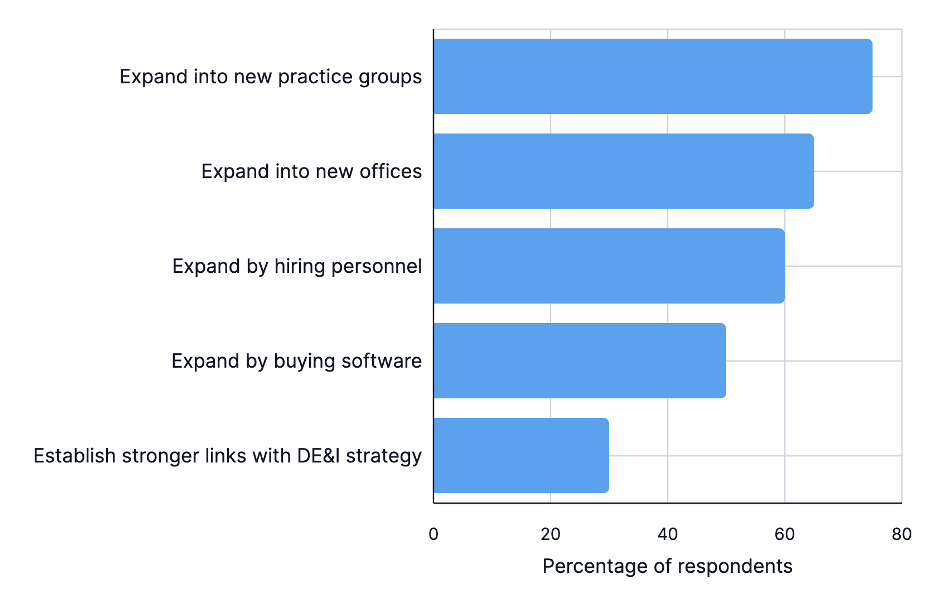
The most common forms of expansion are into new practice groups (74%) and new offices (64%). Meanwhile, 56% of respondents said their firm plans to hire more RMs, and 51% reported plans to invest in dedicated RM software.
Expansion plans for RM programmes
The majority are seeking to expand into new offices and groups.
Interviewees were enthusiastic about the expansion of the function, but expressed reservations about efforts to embed resource management within other operational teams. Some RMs worry that well-intentioned changes to their role could undermine their ability to deliver their unique service.
“I was recently moved into the HR team’s office, and I’ve made it clear in every meeting that I should not sit within that team. If I’m perceived as part of HR, it undermines the effectiveness of my role. People simply won’t raise concerns when a senior HR manager is in the room.”
This raises another question about the future of the function – whether “resource manager” will remain the right job title. We ended our interviews by asking participants if they felt their title adequately reflected their role. Many felt their title was likely to change in the near future.
“That’s an active discussion for us. Many of the existing titles feel too narrow. ‘Resource Management’ doesn’t reflect the HR, talent development, or business strategy dimensions of the role. The direction of travel seems to be toward ‘Business Manager’ or a title that shows how integrated we are within teams and operations.”
Several interviewees noted a growing shift toward the title “Talent Manager,” particularly in the US. Yet nearly two dozen alternative titles were suggested, each with a slightly different emphasis:

Attorney Development Manager
Attorney Engagement Manager
Attorney Integration Manager
Deployment Manager
Experience Management Lead
Legal Engagement Manager
Legal Fee-earner Engagement Manager
Legal Resources & Integration Manager
People & Allocation Manager
People Operations Manager
Practice Manager
Professional Development Manager
Resource & Insights Manager
Resource Advisor
Resource Data Manager
Scheduling Manager
Staffing Manager
Talent Deployment Manager
Talent Development Manager
Talent Management & Development Manager
Work Allocation Manager
Workforce Planning Manager
Workflow Integration Manager
This wide range of suggestions indicates that the role has yet to coalesce around a clear alternative to Resource Manager – if, indeed, one is needed.
“Ultimately, the function is evolving – and the titles will catch up.”
Law firm resource managers know they’re still in the early stages of their respective journeys. Many expressed enthusiasm about helping to shape the future of their firm’s programme, and the function more broadly.
It’s no longer a question of if you do resource management – it’s how. If the aim is just to plug gaps, that isn’t genuine resource management. But if the goal is to develop talent, allocate work fairly, and make more informed decisions, you need both skilled people and a system like Capacity. Together, they are transformative.”


Conclusions
9
This report is published at an exciting juncture for resource management. Two years ago, its status in legal was still uncertain. Two years from now, the function will have achieved maturity across a number of the world’s largest law firms – though perhaps in new and still evolving forms.
The data and insights in this report show just how far the function has come – and how much potential still lies ahead. From reducing the utilisation gap and improving wellbeing to enabling fairer, smarter staffing decisions, resource management is proving its value every day.
Yet perhaps its greatest strength lies in its human side: the ability to understand, connect with, and champion the people behind the numbers. While this value may be reflected in retention rates, engagement scores, or wellbeing surveys, it remains difficult to capture the full impact of resource managers in a single metric – particularly within the fast-paced, high-pressure environment of modern legal teams.Today, RMs are focused on consolidating their impact – communicating their value, securing senior engagement, developing robust KPIs, and landing on the optimal way to organise their time and prioritise their responsibilities.
In the months ahead, technology will continue to elevate what RMs can achieve, freeing up time for more conversations, deeper insights, and more advanced reporting. We look forward to tracking the function’s progress in next year’s report.
This report would not have been possible without the generosity of the resource managers who shared their time and experiences so openly. Their stories have helped paint a vivid picture of a function that is quietly but energetically reshaping how law firms support their talent.
We extend our sincere thanks to everyone who contributed to this report, and an open invitation to any RM reading these words to get involved – by subscribing to our RM-focused newsletter, registering to contribute to the 2027 edition, or joining our growing RM network to share insights and learn from peers across the legal sector. We’ll be in touch about all of these through our mailing list.
We’ll close with a selection of stories that didn’t make it into the main body of the report, but which we felt had to be included.
They demonstrate the very human side of resource management that KPIs may never fully capture.
“One of the fee-earners said quite plainly that Capacity has changed her life, because she no longer spends all her mental energy thinking, ‘I need to reply to this, I need to reply to that.’ There’s both a system and a person managing that for her, allowing her to focus on the work itself. That’s incredibly valuable.”
“I work with associates whose priority is to earn well and move on, so I make sure they’re given work that aligns with that goal. Then there are those who, even in their first year, are determined to make partner. For them, I’m intentional about placing them on the right matters and pairing them with the rainmakers and senior figures who can help raise their profile.”
“You see some people who operate very comfortably at 130%. Take work away from them and they become frustrated. Others sit at around 85%, and anything beyond that starts to create real pressure for them. When you do this role well, you understand each person’s comfort zone. You know when work levels are genuinely too much or too little, whether someone at 60% feels overlooked, or whether they’re at 60% because they’re choosing to stay under the radar.”
“Last month, we had two associates in the same office who were significantly underperforming, each for different reasons. There was extensive discussion across the office about where change needed to occur. As those conversations developed, I noticed our leaders leaning toward retaining the person I believed was the wrong long-term fit. As the resource manager, I see levels of effort and commitment that may not be visible to those reviewing spreadsheets or speaking with fellow partners. I had spoken with both individuals and therefore had a clearer insight. The associate they were initially inclined to let go ultimately remained, because I emphasised that this person deserved the same support we were giving the other – and that, with it, we would have a very capable litigator.
In situations like this, part of my role is helping leaders make difficult decisions when the choice has effectively already been narrowed down. Budget constraints and headcount limitations in that office were fixed, so we had to choose between the two. I believe I helped guide our leaders toward the right decision in that instance.”
“I worked with a very senior associate – around 20 years at the firm – who, for various reasons I wasn’t fully aware of, hadn’t progressed to partnership. He was clearly unhappy, often overlooked, and his utilisation was consistently low. I made a conscious effort to get to know him, understand his needs, and gradually bring him onto more matters. Although I’ve only been with the firm for a year and a half, his performance over the past eight months has really improved. He’s more engaged, colleagues are responding more positively, and I genuinely feel I’ve contributed to that improvement..”
“I’ve stepped in to present balanced, comprehensive feedback when advocates weren’t present – on one occasion, preventing a deserving associate from being unfairly passed over. That person is now a high-achieving partner. Without intervention, we’d have lost them – and all their potential.”
“I don't know how else to put it, but this can’t be a nine-to-five job. You need genuine passion for it. You need strong people skills – listening, engaging, understanding the lawyers you support. I get tired of hearing people speak negatively about lawyers, and I often say, ‘You do realise you're talking to a former lawyer, right? Don’t complain to me about lawyers – I am one. If you don’t understand them, just say so. But you may need to extend yourself; you’re working in a law firm. If you’re serving people you find annoying and don’t understand, you’re in the wrong business.’ You need passion, and a willingness to understand people and see the world from their perspective.”
“A recurring theme has been new joiners. In my previous firm, they’d say in their six-week catch-up, ‘The firm is great, the team is great, everyone is so friendly… but I’m not very busy – is that normal?’ The same pattern, time and again. The same happened with maternity returners. I’d check in – ‘How are things going?’ – and they’d say, ‘All good, everyone has been so kind… but I’m not very busy, do people know I’m back?’ It came up repeatedly. So one of the things I’m focusing on now, in my new firm, is preparing more effectively and ensuring people ramp up more quickly.”
Brought to you by Capacity. Our platform enables law firms to realise the full value of strategic resource management. With integrated tools for tracking, reporting, automation, and allocation, Capacity provides a comprehensive solution that helps firms utilise their talent to their full potential.
”Legal Digest” mailer 📩
The State of Resource Management in Legal 2026
WHITEPAPER – JAN 2026

ExecutiveSummary
1
Introductionto RM
2
RM in 2026
3
StrategicImpact
4

CapacityCase Study
5
Challenges &Opportunities
6
The Role ofTechnology
7

TheFuture
8
Conclusions
9
Brought to you by Capacity. Our platform enables law firms to realise the full value of strategic resource management. With integrated tools for tracking, reporting, automation, and allocation, Capacity provides a comprehensive solution that helps firms utilise their talent to their full potential.
”Legal Digest” mailer 📩Key findings
14% average reduction in the utilisation gap
Resource managers have overseen a meaningful decrease in the gap between the busiest and quietest lawyers.
Associates trust RMs with information they might not otherwise share
More than 9 in 10 say associates come to them first.
Nearly half of work still bypasses RMs
45% of all work flows around, rather than through, the RM function.
KPI frameworks are still rare
Just 30% of RMs operate with established performance metrics.
Partner engagement remains inconsistent
60% say some partners have yet to fully buy in to the RM programme.
Workloads exceed what RMs consider ideal
More than 2 in 3 (69%) manage more fee-earners than they believe is sustainable.
Expansion is on the horizon
3 in 4 firms plan to grow their RM function within the next year.
ExecutiveSummary
1
The data gathered for this year’s report offers the clearest picture yet of how resource management is evolving inside leading law firms.
It’s clear the function has made measurable progress: narrowing utilisation gaps, strengthening relationships with associates, and embedding itself more firmly within the operational fabric of firms.
At the same time, we understand better the pressures RMs continue to face: inconsistent partner engagement, heavy workloads, limited KPIs, and the persistent volume of work that bypasses the function altogether.
Taken together, the insights illustrate a discipline that is simultaneously maturing and stretching.
Having worked closely with RMs for nearly a decade, I was delighted to see their value captured here — not only in the metrics, but in the human side of the role too.
At Capacity, we believe resource management is one of the most influential processes in large law firms. Resource managers sit right at the centre of it all, giving firms – and technology companies – the insight to work smarter and better.
We’re already looking ahead to next year’s report. If you’d like to take part, I’d love to hear from you.
William DoughertyCapacity Co-founder & CEO
Key:
Quotes from RMs who use Capacity are contained in these boxes.
More expansive RM impact stories are contained in these boxes.
Introduction
Over the past decade, resource management has developed from a nice-to-have to a must-have for large international law firms.
Leaders are increasingly recognising that innovation in staffing can be a powerful driver of efficiency, development, talent retention, and long-term competitiveness.
Yet despite its growing importance, resource management is still an emerging discipline in the legal sector.
In this paper, we share insights from 52 survey respondents and 21 in-depth interviews with practising law firm resource managers.
Collectively, they represent more than 235 years of experience in the legal sector. This is a first-of-its-kind report on their experiences, challenges, and successes.
In publishing their insights, our goal is to inspire best practices, foster collaboration, and help shape the future of resource management in law firms.
With data collected in Q3 2025, this report marks the first in an annual series. To contribute to the 2027 edition, or to receive updates on future reports, ensure you’re signed up to Capacity’s newsletter. You can do so on capacity.law.
Demographics
Where do you work?
How many lawyers are there at your firm?
Introductionto RM
2
Resource management is long established in consulting and professional services firms, where it has been used to optimise talent utilisation and performance for decades. As law firms have expanded and client expectations around efficiency and cost control have grown, the legal sector has increasingly embraced the function.
Most firms represented in our survey created their resource management function between 2016 and 2022. With a median tenure of five years, most RMs have had time to get their feet under the desk – but may be yet to become fully established.
When firms launched resource management
Most programmes emerged between 2016 and 2025.
Acknowledging the relative novelty of their roles, interviewees described how misconceptions about the function, and a limited understanding of their work, are barriers to broader engagement. So who are resource managers, and what do they do?
“Some people still don’t understand what we do, or think we’re just admin support. That makes it harder to have the right conversations.”
“There’s a misconception that RM is just work allocation – but it’s a lot more than that.”
Who are resource managers?
Our survey responses indicate there are two distinct routes into law firm resource management. Some RMs move into the legal sector from a similar role in the Big Four. This route is more established in the UK, with these RMs tending to report they “fell into” their law firm roles.
Others become an RM having previously worked as a lawyer, often within the same firm – a path that’s currently more common in the US.
Previous experience of resource managers
Almost 3 in 4 had previous experience as a lawyer or an RM outside legal.
Both types of RM face a learning curve: former lawyers must learn the ins and outs of resource management, while those new to the legal sector must grasp the nuances of legal work and the unique culture within law firms.
Background of UK and US resource managers
Radically different hiring approaches exist on either side of the Atlantic.
“People who have trained at a consultancy generally come in with a good awareness of what resource management is, and the levers they need to pull to make things happen.”
“Legal experience helps. If a partner asks for somebody to support an M&A transaction, you can't say, ‘well, I've got this tax associate over here.’”
Key traits
Resource managers occupy a unique, holistic position within their firms. Several interviewees emphasised that they “wear different hats,” operating between departments to deliver a mix of resourcing, analysis, and pastoral care.
“We're a depot of information, and we’re constantly funnelling that data out to different people: to HR, to talent, to finance.”
Besides their resourcing responsibilities, respondents were evenly split between viewing their role as primarily pastoral or primarily analytical. In reality, as we shall see throughout this report, resource management involves a large dose of both.
57%
Say their role is largely pastoral.
55%
Say their role is largely analysis and reporting.
We asked each of our interviewees for the traits they see as most important to be a successful resource manager. This word cloud shares their most frequent responses.
Most important traits for resource managers
Resilience was cited by 90% of interviewees.
Resource managers consistently emphasised strong people skills as essential to their role. The most frequently cited trait – mentioned by 90% of interviewees – was resilience. For RMs, this often means the ability to withstand partner pushback and persuade juniors to take on less desirable work.
“Thick skin. You’re pushing back against very experienced partners. You need to be able to negotiate, to say ‘I can’t give you exactly what you want, but here’s an alternative that still works.’”
On the other hand, RMs need to build trust and rapport with juniors and seniors alike. Many also provide informal pastoral support, acting as a safety valve for overworked or vulnerable associates who may hesitate to raise concerns elsewhere.
“Sometimes we’re a safe space to vent, to shout, even to cry. Our role is about listening, understanding, and really building those relationships.”
This experience is almost universal among RMs: nine in ten survey respondents said they often hear concerns that would otherwise go unspoken, and unresolved, within their firms.
92%
Say associates trust them with information they might not otherwise share.
Every resource manager we interviewed shared at least one story illustrating how valuable this unofficial, backchannel communication and support can be for law firms and their lawyers.
“I had an associate. A hard worker, but prone to stress. She's tells me: ‘I've been working hard to get pregnant, and I’m finally pregnant – with twins – but I'm not announcing yet because it’s early stage. I’m worried about preterm labour.’ So I helped manage her schedule, keeping her safe from demanding work, from difficult people. She went on to have her babies, and she was extremely grateful. In any case, it's not good to put her on a deal that's going to go months and months – we’d have to replace her, and all that institutional knowledge, and ask the client to pay more money to get somebody else up to speed. So it worked for her and it worked for us.”
RM in 2026
3
To assess the state of resource management in 2026, we asked respondents to describe the scale of their functions. An interesting pattern emerged: firms with 1,000–2,000 lawyers employed the most RMs, while the very largest firms had among the fewest.
Number of RMs versus lawyers at the firm
Firms with between 1,000 and 2,000 lawyers have the most RMs.
The data reveals wide variation in the deployment of the RM function across firms. Some large firms have as few as one RM per 2,000 lawyers, suggesting RMs are active in very few teams, while others operate at ratios below one to 100, suggesting a whole-firm roll-out.
Number of resource managers: UK versus US
US firms have more RMs than UK firms, on average.
This disparity may also reflect differing strategic approaches to the function, with some firms opting to replicate the Big Four model in which RMs have a more limited role but manage far larger teams.
“In consulting, I was looking after a larger number of people. I would put them on a project and that's it – off they go for six months, and you don't have to worry about them until they pop up in your system again. Whereas in legal, people are always here unless they’re on secondment. I’m constantly talking to them, constantly giving them work, and discussing what they like about it. So you are forming stronger relationships with people. That's one of the things I really value about working in legal.”
However, most RMs said their firms are planning to expand their teams, suggesting their programmes are regarded as successful by firm leaders.
75%
Say their firm is planning to expand the RM programme in the next year.
56%
Say their firm is planning to hire more RM personnel in the next year.
Survey respondents were also asked to identify their ideal ratio of RMs to lawyers. Responses varied from 1:30 to 1:150, though most clustered between 1:50 and 1:100. On average, the RMs we surveyed would like to be responsible for 82 lawyers.
Resource managers’ ideal RM-to-lawyer ratio
RMs would prefer to oversee 82 lawyers, on average.
Many RMs emphasised that the ideal ratio will vary by team and practice area. Fast-paced groups typically need more RM support, while teams with junior lawyers require greater oversight than those with more experienced fee-earners.
“Disputes requires less frequent resourcing because the matters are larger and longer-lasting. But transactional practices such as Real Estate require more day-to-day resourcing – so more work for the RM.”
When asked to explain their ideal ratio, RMs cited three closely linked factors: maintaining personal relationships, fulfilling all responsibilities effectively, and building a detailed understanding of each lawyer’s professional profile.
Why resource managers would limit team size
Two in three cited the ability to know each team member’s profile.
Resource managers want to serve teams that they can realistically get to know, support, and serve on a personalised basis. Above a certain threshold, that service becomes impossible and their role becomes more transactional.
“Every fee-earner requires something different, and it’s important we have time to deliver the service to each of them. From my experience, any more than 130 people becomes unmanageable.”
Respondents also shared the size of the teams they manage. The smallest was 15 lawyers, the largest 380, with an average of 128. Nearly half (48%) oversee 100 or more lawyers, while only 14% manage fewer than 50. On average, RMs are managing 46 more lawyers than they see as ideal.
RM actual team size versus ideal team size
On average, RMs are managing 46 more lawyers than they see as ideal.
Comparing each resource manager’s ideal ratio with the size of their team, more than two-thirds are managing more lawyers than they consider optimal. Some 15% are managing teams more than twice the size they consider ideal.
69%
Manage more lawyers than they think is ideal.
Finally, those surveyed were asked which of their firm’s practice groups are currently covered by the RM function.
Practice group coverage
Resource management is most deployed in fast-paced teams.
Fast-paced teams are over-represented in these findings, suggesting that firms are prioritising RM support for practice groups with a higher turnover of work.

StrategicImpact
4
As resource management becomes more established across the legal sector, its impact across a diverse range of firms and practice groups is becoming clearer. With most resource managers having spent several years in their roles, they are well placed to assess how their work is shaping team performance, firm culture, and fee-earner wellbeing.
When asked to rate their influence across key areas, respondents identified their strongest impact on wellbeing (8.6/10), smoothing utilisation (8.3/10), and talent retention (7.8/10) – three priorities at the heart of what resource management seeks to achieve.
Perceived influence over key areas
RMs believe they have the greatest impact on wellbeing.
Interestingly, respondents were less confident about their impact on profitability and client satisfaction – areas where the benefits of resource management may be harder to assess and quantify. This likely reflects a maturing function, still evolving from an administrative role to one of strategic influence across the firm. Several interviewees noted that this shift is already well under way within their own organisations.
“We're not just chasing forecasts and filling requests any more. We work with every group: HR, finance, recruitment, wellbeing, D&I, pricing. We help break down the structure of the teams we’re putting forward to clients. We're even part of pitch documents now. Partners include sections about resource management: how we staff matters, or what we consider when building teams.”
When given the access they need, having earned the trust of senior lawyers, resource managers can support a wide range of firm functions. But the impact most central to their role, and top of mind for nearly every RM, is smoothing utilisation.
Smoothing utilisation
One of the key objectives of resource management is to distribute work more evenly – reducing the number of associates working far above or below target.
This is described by resource management professionals as smoothing utilisation, flattening the utilisation curve, or narrowing the utilisation gap. It’s widely regarded as a core KPI of resource management – with caveats.
“Utilisation targets are useful, but you have to have the work. If you don’t have the work, then those targets will be unachievable.”
To explore this key metric, we asked survey respondents to report their team’s current utilisation gap and indicate whether resource management had helped to reduce it. Notably, only 5% of respondents couldn’t provide this data – underscoring its centrality to their work and how they assess their performance.
50%
Average pre-RM utilisation gap.
36%
Average post-RM utilisation gap.
Across our sample, resource management reduced the utilisation gap by an average of 14% – a strong result for a relatively new function. Two in three respondents (68%) reported a current utilisation gap exceeding 30%, with none having reduced it to 10% or below. However, every RM said they had helped narrow their team’s gap, with seven in ten reporting a reduction of more than 10%.
Current utilisation gap in RM teams
Two in three report a utilisation gap exceeding 30%.
RM’s reduction of the utilisation gap
Seven in ten report a reduction of more than 10%.
RM impact on the utilisation gap
RMs have reduced the utilisation gap by an average of 14%.
Unsurprisingly, programme maturity was strongly correlated with overall improvement: firms with older RM programmes and larger RM teams achieved the greatest reductions to their utilisation gaps.
Our interviews revealed that the utilisation gap is often viewed as a measurable proxy for the broader, less tangible benefits of resource management. We asked survey respondents to identify those benefits.
Perceived benefits of utilisation smoothing
Fairness and reduced burnout rank as the top benefits.
The reported benefits underscore the win-win nature of resource management: supporting healthier, more engaged associates who stay longer and contribute more to their firms and clients.
“It's about ensuring every attorney has fair access to opportunities, supporting their skills development, and building a broad, highly capable talent pool to meet client demands – while safeguarding the wellbeing of those with the heaviest workloads.”
Some firms may focus on raising the hours of their least busy lawyers. But as one RM noted, protecting promising talent from overwork is just as important as supporting those at risk of underutilisation and disengagement.
“On the other hand, some associates do just put their heads down and work. In some cases, I will explain that ‘no, you need to take out 400 of these hours. You had 3,000 hours, so take four or five hundred of these hours and turn them into interacting with the partnership, going out for drinks, and using your BD money.’ We had two associates like that become partners this year – and I felt I influenced that. It's those stories, those interventions, that are sometimes overlooked.”

CapacityCase Study
5
The utilisation gap is a core KPI we at Capacity use to measure the effectiveness of our solution as it’s deployed across new teams.
In one team at a leading law firm, Capacity was adopted to help its resource managers narrow the utilisation gap and optimise workload distribution.
Using Capacity, the team’s resource manager tracked associate data, generated reports, and intervened when partner assignments appeared suboptimal. The utilisation gap was measured before implementation and again six months later.
54%
Utilisation gap before Capacity.
18%
Utilisation gap after six months using Capacity.
This 36% reduction in the utilisation gap is unprecedented in the legal sector. The team began with an above-average gap but, six months later, ranked in the top tenth percentile for utilisation balance among all teams in this report.
The RMs in this team said they typically checked in with associates when utilisation fell below 70% or approached 100%, to assess under- or overwork. Capacity helped keep workloads within the right range, reducing the need for reactive interventions.
Utilisation range before and after Capacity
Capacity helped RMs achieve a 36% reduction in the utilisation gap.
In this period, 119 matters and 1,001 tasks were created and staffed in Capacity – an average of 8 tasks per day. The majority of these tasks did not require the RM’s intervention, freeing up time for higher value work.
“Capacity ensures we no longer shoulder responsibility for every individual resourcing request. Partners use the system independently, and I step in only when we need to consider how to optimise a situation, resolve an issue, or refine the reporting. My role has become more strategic.”
With more time freed up, RMs can focus on higher-value activities such as workforce planning, pastoral support, and talent development. The resource manager in this team estimated that Capacity saved them between three and four hours per day.
50%
Reported time recovery for RMs using Capacity.
Capacity is intentionally flexible, allowing firms to deploy it in different ways. Some teams have resource managers enter all work into the system, others encourage fee-earners to use the work allocation features directly where appropriate, and some opt for a hybrid approach.
The programme’s success has smoothed adoption across the firm, giving other RMs confidence and momentum as they prepare to implement Capacity themselves.
“I recently met with a team that doesn’t yet use Capacity, and they said they’re genuinely looking forward to adopting it. To me, that speaks volumes – it shows we’re building advocates not only for Capacity, but for effective resource management more broadly.”
Fee-earner attrition is another clear indicator of Capacity’s impact. Before implementation, attrition in the team stood at 12.7%. Around a year after deployment, it had fallen to 7.7% – a reduction of more than one-third year on year.
39%
Decrease in associate attrition in teams using Capacity after one year.
Research indicates that losing a single associate can cost between $500,000 and $1 million. On that basis, Capacity’s impact on retention could be delivering savings of several million dollars for this team alone.
We’re proud to support resource managers across firms and practice areas as they formalise and centralise their approach to resource management – unlocking the full productivity potential of their people.

Challenges &Opportunities
6
As a growing function, it’s natural for resource management to encounter challenges along the way. We asked RMs to share what’s holding them back – and what lessons could help the function continue to evolve and gain momentum across the legal sector.
One theme came up repeatedly: time. RMs report feeling stretched – across too many lawyers, too many matters, and too many competing responsibilities. As one RM put it, regaining time would mean “moving from managing panic to managing people.”
We asked RMs how they currently spend their time. The good news: RM programmes are reducing the time required to allocate work. The less good news: despite greater formalisation, 40% of respondents still spend most of their time on work allocation – which means less time on longer-term, strategic activity.
71%
Say the RM programme has reduced the time it takes to allocate work.
40%
Say they spend the majority of their time allocating work.
Resource managers don’t just allocate work – though several interviewees said this remains a common misconception. While work allocation focuses on assigning tasks to fee-earners, more holistic resource management involves a far broader set of responsibilities that underpin team performance and strengthen the firm as a whole.
RMs told us that there’s still a communication challenge in helping senior lawyers understand that allocation is just one part of a much broader role.
“The role extends far beyond allocating work. There’s pastoral, there’s coaching, there’s wellbeing, there’s analysis. It carries genuine advisory weight, and that influence is strengthened when we can support our recommendations with robust data.”
Our survey found that two in three RMs believe they could enhance their pastoral support with more time, and over half said additional time would enable better analysis and reporting.
67%
Say they could deliver more value if they had more time for pastoral activity.
55%
Say they could deliver more value if they had more time for analysis and reporting.
High-quality reporting can have a powerful long-term impact on team profitability, but those reports must be regarded as legitimate for groups to act on their insights.
“Years ago, I saw a spike in public sector IPO work coming. By aggregating partner insights and Capacity data, I warned we needed to hire or risk turning work away. Unfortunately, we didn’t act in time. We became overloaded, missed opportunities, and ended up hiring late and at higher cost, bringing in people who weren’t the best fit. Some team members burned out or permanently pulled back, reducing our long-term capability.”
Ultimately, firms must decide how much they’re willing to invest in resource management. Expanding RM teams, supported by technology that automates their most time-consuming tasks, may be key to unlocking the function’s full strategic potential.
The ‘cultural hump’
Resource management depends on cultural change and partner buy-in to succeed. Many partners remain accustomed to delegating to familiar associates, and such ingrained habits can be hard to break – especially in firms where the function is still considered unproven.
“It all comes down to overcoming the cultural hump. You can sit around a table outlining all the advantages of the function, and everyone will agree enthusiastically – that part is easy. The real test comes on Monday morning, when you’re asking someone to change the way they work.”
RMs unanimously agreed that partner buy-in is essential to programme success, yet nearly two-thirds said some seniors remain unconvinced. This may frustrate RMs, but most interviewees told us they understand partner resistance and view winning seniors over as part of their role.
100%
Say partner buy-in is essential for the success of the RM programme.
60%
Say some seniors have yet to buy in to the RM programme.
Respondents cited favouritism as the main barrier to senior buy-in, noting that partners often prefer familiar associates and hesitate to release them for other matters. Trust also emerged as a key issue: some partners are wary of assigning work to juniors they don’t know, and others doubt that RMs have the authority to influence or override their staffing choices.
Barriers to senior buy-in
Favouritism was cited by more than one in three respondents.
“The teams that have followed my advice are seeing strong results. Where teams have chosen a different path, challenges are emerging. We can provide the tools, but that doesn’t guarantee success – which is why the shift in mindset is so important.”
“Inconsistent adoption among partners and senior lawyers means the system can only operate partially, creating a tiered environment where some follow the guidelines and others don’t. This leads to operational issues, mutual frustration, and ultimately undermines the credibility the system needs to deliver its value.”
When senior lawyers aren’t fully behind the programme, they tend to continue doing things “the old way.” Our survey found this to be the case, to varying degrees, across all RM teams – with a significant minority reporting that fewer than one in three tasks are routed through the RM programme.
Volume of work routed through RM programme
Nearly half (45%) of work remains outside RM programmes.
On average, RMs report that only 55% of work currently passes through their RM programmes. This suggests that some senior lawyers prefer to bypass the system, or that some teams may prefer for certain work to be assigned outside the system.
“Some partners need a nudge to ensure all work is put through Capacity. When activity happens outside the system, that’s when our value is diluted and our fee-earners begin to feel the strain.”
Some interviewees suggested that partners might use RM programmes to offload less desirable work. Our survey tested this assumption and found that nearly two-thirds (65%) of respondents disagreed, with fewer than one in five agreeing.
45%
Of work still bypasses the RM programme, on average.
17%
Say the work that goes through the RM programme is the least desirable.
Buy-in issues are far from universal. Many interviewees cited partners who have become active champions of their programmes, and three-quarters of respondents agreed that partners recognise their value to the firm.
75%
Say partners understand the value they contribute to the firm.
“Where buy-in is strong, it works brilliantly. One partner made it clear the system was non-negotiable and led by example. Usage soared, the team became more diverse, and the culture shifted. That’s what we need elsewhere.”
It’s not only senior lawyers who sometimes disengage from the RM function. Some juniors also fail to participate fully in the programme – often requiring encouragement to reengage.
“One associate was struggling to secure work post-secondment. They’d disengaged from the system and hadn’t updated their preferences. I encouraged them to take a few moments to do so, and by the end of the week they had three strong assignments, including one with a preferred partner. It showed how small, informed adjustments can deliver significant results.”
Still, some seniors continue to view RM as an administrative layer rather than a strategic asset. Our interviewees believe that demonstrable wins – such as improved utilisation, faster staffing, and successful new connections – can help change perceptions, build trust, and shift long-standing habits.
A lack of KPIs
Which brings us to the next challenge: the lack of defined KPIs for resource management. While two-thirds of RMs said their firms have a clear resourcing strategy, fewer than one in three reported having formal KPIs to measure the effectiveness of their work.
65%
Say their firm has a clear resourcing strategy.
30%
Say they work with formalised KPIs.
The absence of formal KPIs is understandable: as one interviewee put it, the function “is not an exact science.” Others noted that much of a resource manager’s value is difficult to measure, particularly the pastoral, ear-to-the-ground elements of their work.
“There’s no KPI for the pastoral side of the role, nor for the insight it enables me to provide to senior stakeholders. You’d be surprised by how much you observe in this position – who’s thriving, who’s finding things difficult, who people enjoy working with, where there are tensions. All that means we act as an early warning system when individuals are at risk of burnout.”
Despite this, almost every interviewee, when asked about their KPIs, wanted to know what other firms were measuring. There’s a clear appetite for more robust metrics – for better ways to evidence to senior stakeholders what RMs already see in practice.
“We’ve saved nearly 1,000 hours of partner time on resourcing alone. When you multiply that by the average partner rate, you’re looking at significant savings.”
To help consolidate emerging resource management KPIs, we’ve compiled a list of the metrics shared with us through interviews and our broader work with resource managers.
The utilisation gap
Changes in overall utilisation
Proportion of work requests routed through the function
Fee-earner engagement survey results
Feedback from fee-earner interviews
Profitability: whether the most cost-effective resources were selected
Partner time saved
Diversity and inclusion alignment
Wellbeing outcomes
Growth in internal connections and collaboration
Reduction in associate sick days
Many of these KPIs are already monitored by law firms. RM teams in search of additional KPIs may wish to push for stronger alignment with the metrics used by other departments and programmes.
“We’ve aligned our wellbeing KPIs with our resourcing KPIs. That way, when we speak to partners, we’re not just warning ‘this person is too busy’ – we’re saying, ‘this affects their wellbeing and performance.’ It’s a stronger message.”
Resource managers shared a strong appetite to connect: to discuss potential KPIs, exchange best practices, and contribute to the growth and recognition of the function across the legal sector.
Throughout 2026, Capacity will help build and strengthen these connections by engaging resource managers via our mailing list to arrange structured roundtables, peer discussions, and collaborative forums, creating a consistent platform for knowledge-sharing and professional development.

The Role ofTechnology
7
Resource managers sit at the intersection of two worlds: one deeply human, the other highly data-driven. They’re expected to collect, process, and analyse fee-earner data while maintaining the personal connection that builds trust and fosters a sense of belonging within their firms.
“It’s a people role – we just need the data. For me, data is the greatest enabler. In an ideal setup, you glance at a dashboard and immediately know which partner to speak to about whom.”
Technology is designed to enhance – not replace – the role of resource managers. Its purpose is to relieve RMs of time-consuming manual data collection and processing, allowing them to focus on the strategic and human elements of the job that technology cannot replicate.
Two in three survey respondents reported using dedicated resource management software, with adoption broadly consistent across US and UK firms.
67%
Use dedicated resource management software.
Surprisingly, the largest firms represented in our survey (those with more than 3,000 lawyers) were far less likely to have deployed RM software than firms with between 1,500 and 3,000 lawyers (25% versus 95%).
This may reflect the distinct procurement processes of the world’s largest law firms, as well as the structural barriers that can make agile technology adoption more difficult at that scale.
Access to RM software versus firm size
The largest firms are least likely to use RM technology.
On average, RMs with access to dedicated software rated their impact higher than those without specialised technology. The difference was most pronounced in areas such as client satisfaction and lateral and returnee integration.
RM impact with and without technology
RMs using specialised software report greater impact.
Whether or not RMs reported using specialised software, more than four in five said they could do a better job with better technology. Respondents believed that tracking and reporting would benefit most from better technology, followed by fee-earner data analysis and collection.
83%
Say they could do a better job with better resource management technology.
Where technology could be most impactful
RMs see technology as most helpful in managing data.
RMs most closely associate technology with the data side of their roles – the aspect many described as most tedious when handled manually. Just two in five respondents said they find it easy to gather fee-earner data, even before accounting for the time required to organise and analyse it for staffing decisions.
42%
Say it’s easy to gather data on fee-earners.
“I used to spend half a day each week compiling reports – four or five hours not engaging with stakeholders or focusing on strategic work. With technology, you get to the answer quickly, freeing up time to consider the real question: ‘What should we do with these insights?’”
“Before Capacity, everything was manual. I had to speak personally with more than 100 lawyers about their aspirations and track all of it myself. I did my best, but inevitably human error crept in – you remember the most vocal person, or the last conversation you had, rather than the best fit. It was the stone age of resourcing.”
While technology is a valuable and welcome tool for RMs, respondents and interviewees were clear that it can never replace them – no matter how advanced it becomes.
“Tech can’t know what’s happening in someone’s life. It can’t replace relationships, chats over coffee, or personal insight. That’s human.”
At Capacity, we’ve seen the firms we work with significantly increasing their RM headcount. As one interviewee noted, technology can strengthen the case for hiring more RMs, rather than serving as a reason to reduce their number.
“For the first time, we have systems that return rich, actionable data. Once firms understand the insights available – about workload, skills gaps, profitability – they’ll realise they need experienced RM teams to act on it.”
Overall, RMs expect technology to continue enhancing their capabilities in the near future. But what lies ahead for the function itself? What’s next for resource management in the legal sector?

TheFuture
8
Resource management is still developing in the legal sector, but its trajectory is becoming clearer. Future-facing firms increasingly recognise that innovation in this area delivers significant returns – from stronger retention and higher productivity to time savings and a healthier firm culture.
“Ten years ago, resource management barely existed in law. Now, it’s growing fast.”
Three-quarters of survey respondents told us their firm plans to expand the function – a clear sign that firms that have already invested in resource management see its value and intend to build on early successes.
75%
Say their firm is expanding its RM function.
The most common forms of expansion are into new practice groups (74%) and new offices (64%). Meanwhile, 56% of respondents said their firm plans to hire more RMs, and 51% reported plans to invest in dedicated RM software.
Expansion plans for RM programmes
The majority are seeking to expand into new offices and groups.
Interviewees were enthusiastic about the expansion of the function, but expressed reservations about efforts to embed resource management within other operational teams. Some RMs worry that well-intentioned changes to their role could undermine their ability to deliver their unique service.
“I was recently moved into the HR team’s office, and I’ve made it clear in every meeting that I should not sit within that team. If I’m perceived as part of HR, it undermines the effectiveness of my role. People simply won’t raise concerns when a senior HR manager is in the room.”
This raises another question about the future of the function – whether “resource manager” will remain the right job title. We ended our interviews by asking participants if they felt their title adequately reflected their role. Many felt their title was likely to change in the near future.
“That’s an active discussion for us. Many of the existing titles feel too narrow. ‘Resource Management’ doesn’t reflect the HR, talent development, or business strategy dimensions of the role. The direction of travel seems to be toward ‘Business Manager’ or a title that shows how integrated we are within teams and operations.”
Several interviewees noted a growing shift toward the title “Talent Manager,” particularly in the US. Yet nearly two dozen alternative titles were suggested, each with a slightly different emphasis:
Attorney Development Manager
Attorney Engagement Manager
Attorney Integration Manager
Deployment Manager
Experience Management Lead
Legal Engagement Manager
Legal Fee-earner Engagement Manager
Legal Resources & Integration Manager
People & Allocation Manager
People Operations Manager
Practice Manager
Professional Development Manager
Resource & Insights Manager
Resource Advisor
Resource Data Manager
Scheduling Manager
Staffing Manager
Talent Deployment Manager
Talent Development Manager
Talent Management & Development Manager
Work Allocation Manager
Workforce Planning Manager
Workflow Integration Manager
This wide range of suggestions indicates that the role has yet to coalesce around a clear alternative to Resource Manager – if, indeed, one is needed.
“Ultimately, the function is evolving – and the titles will catch up.”
Law firm resource managers know they’re still in the early stages of their respective journeys. Many expressed enthusiasm about helping to shape the future of their firm’s programme, and the function more broadly.
It’s no longer a question of if you do resource management – it’s how. If the aim is just to plug gaps, that isn’t genuine resource management. But if the goal is to develop talent, allocate work fairly, and make more informed decisions, you need both skilled people and a system like Capacity. Together, they are transformative.”

Conclusions
9
This report is published at an exciting juncture for resource management. Two years ago, its status in legal was still uncertain. Two years from now, the function will have achieved maturity across a number of the world’s largest law firms – though perhaps in new and still evolving forms.
The data and insights in this report show just how far the function has come – and how much potential still lies ahead. From reducing the utilisation gap and improving wellbeing to enabling fairer, smarter staffing decisions, resource management is proving its value every day.
Yet perhaps its greatest strength lies in its human side: the ability to understand, connect with, and champion the people behind the numbers. While this value may be reflected in retention rates, engagement scores, or wellbeing surveys, it remains difficult to capture the full impact of resource managers in a single metric – particularly within the fast-paced, high-pressure environment of modern legal teams.Today, RMs are focused on consolidating their impact – communicating their value, securing senior engagement, developing robust KPIs, and landing on the optimal way to organise their time and prioritise their responsibilities.
In the months ahead, technology will continue to elevate what RMs can achieve, freeing up time for more conversations, deeper insights, and more advanced reporting. We look forward to tracking the function’s progress in next year’s report.
This report would not have been possible without the generosity of the resource managers who shared their time and experiences so openly. Their stories have helped paint a vivid picture of a function that is quietly but energetically reshaping how law firms support their talent.
We extend our sincere thanks to everyone who contributed to this report, and an open invitation to any RM reading these words to get involved – by subscribing to our RM-focused newsletter, registering to contribute to the 2027 edition, or joining our growing RM network to share insights and learn from peers across the legal sector. We’ll be in touch about all of these through our mailing list.
We’ll close with a selection of stories that didn’t make it into the main body of the report, but which we felt had to be included.
They demonstrate the very human side of resource management that KPIs may never fully capture.
“One of the fee-earners said quite plainly that Capacity has changed her life, because she no longer spends all her mental energy thinking, ‘I need to reply to this, I need to reply to that.’ There’s both a system and a person managing that for her, allowing her to focus on the work itself. That’s incredibly valuable.”
“I work with associates whose priority is to earn well and move on, so I make sure they’re given work that aligns with that goal. Then there are those who, even in their first year, are determined to make partner. For them, I’m intentional about placing them on the right matters and pairing them with the rainmakers and senior figures who can help raise their profile.”
“You see some people who operate very comfortably at 130%. Take work away from them and they become frustrated. Others sit at around 85%, and anything beyond that starts to create real pressure for them. When you do this role well, you understand each person’s comfort zone. You know when work levels are genuinely too much or too little, whether someone at 60% feels overlooked, or whether they’re at 60% because they’re choosing to stay under the radar.”
“Last month, we had two associates in the same office who were significantly underperforming, each for different reasons. There was extensive discussion across the office about where change needed to occur. As those conversations developed, I noticed our leaders leaning toward retaining the person I believed was the wrong long-term fit. As the resource manager, I see levels of effort and commitment that may not be visible to those reviewing spreadsheets or speaking with fellow partners. I had spoken with both individuals and therefore had a clearer insight. The associate they were initially inclined to let go ultimately remained, because I emphasised that this person deserved the same support we were giving the other – and that, with it, we would have a very capable litigator.
In situations like this, part of my role is helping leaders make difficult decisions when the choice has effectively already been narrowed down. Budget constraints and headcount limitations in that office were fixed, so we had to choose between the two. I believe I helped guide our leaders toward the right decision in that instance.”
“I worked with a very senior associate – around 20 years at the firm – who, for various reasons I wasn’t fully aware of, hadn’t progressed to partnership. He was clearly unhappy, often overlooked, and his utilisation was consistently low. I made a conscious effort to get to know him, understand his needs, and gradually bring him onto more matters. Although I’ve only been with the firm for a year and a half, his performance over the past eight months has really improved. He’s more engaged, colleagues are responding more positively, and I genuinely feel I’ve contributed to that improvement..”
“I’ve stepped in to present balanced, comprehensive feedback when advocates weren’t present – on one occasion, preventing a deserving associate from being unfairly passed over. That person is now a high-achieving partner. Without intervention, we’d have lost them – and all their potential.”
“I don't know how else to put it, but this can’t be a nine-to-five job. You need genuine passion for it. You need strong people skills – listening, engaging, understanding the lawyers you support. I get tired of hearing people speak negatively about lawyers, and I often say, ‘You do realise you're talking to a former lawyer, right? Don’t complain to me about lawyers – I am one. If you don’t understand them, just say so. But you may need to extend yourself; you’re working in a law firm. If you’re serving people you find annoying and don’t understand, you’re in the wrong business.’ You need passion, and a willingness to understand people and see the world from their perspective.”
“A recurring theme has been new joiners. In my previous firm, they’d say in their six-week catch-up, ‘The firm is great, the team is great, everyone is so friendly… but I’m not very busy – is that normal?’ The same pattern, time and again. The same happened with maternity returners. I’d check in – ‘How are things going?’ – and they’d say, ‘All good, everyone has been so kind… but I’m not very busy, do people know I’m back?’ It came up repeatedly. So one of the things I’m focusing on now, in my new firm, is preparing more effectively and ensuring people ramp up more quickly.”
Brought to you by Capacity. Our platform enables law firms to realise the full value of strategic resource management. With integrated tools for tracking, reporting, automation, and allocation, Capacity provides a comprehensive solution that helps firms utilise their talent to their full potential.
”Legal Digest” mailer 📩